
Begin with a trip everyone has actually agreed to
Choose the festival, edition, accommodation approach and people sharing the estimate before entering numbers. A tentative group of six and a confirmed group of four produce different per-person costs even if the campsite price is unchanged. Put the date of your research and the current group size in the notes. If one friend is deciding later, keep that possibility separate rather than treating an unconfirmed contribution as money already available. The festival selection guide helps narrow the choice around music and practical needs. This dashboard then gives the chosen trip a working structure. It does not reserve a campsite, verify a ticket or maintain a live connection to an event’s inventory. The figures and activities remain the information you enter, so review them after any booking changes.
Separate admission, campsite and access products
Read each product description before putting a single camping amount into the budget. WE Fest’s published camping guidance separates the campsite purchase from individual campground access wristbands and festival admission.1 Boots and Hearts likewise states that its camping pass is sold per site and does not provide entertainment-area admission.2 These examples show why a campsite confirmation alone may not cover every person’s access; use the current edition’s own wording for your trip. Put per-person admission and checkout charges in their individual fields. Put the shared campsite total in the group camping field. If an access charge applies to every traveller, account for it consistently in the per-person estimate or record it clearly under other group costs. Avoid entering the same expense in two places just because the organiser sells a bundle.
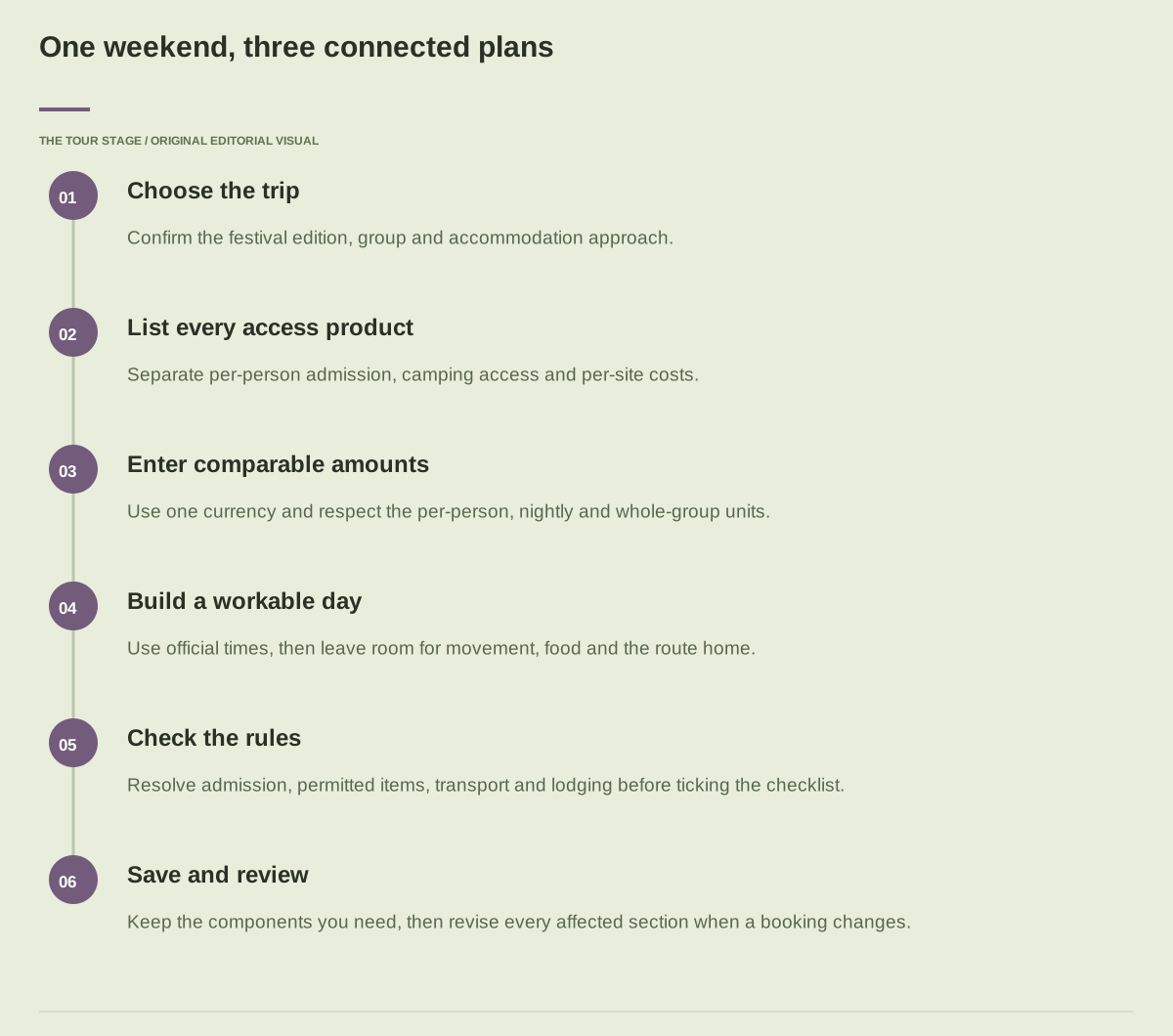
One weekend, three connected plans
- Choose the tripConfirm the festival edition, group and accommodation approach.
- List every access productSeparate per-person admission, camping access and per-site costs.
- Enter comparable amountsUse one currency and respect the per-person, nightly and whole-group units.
- Build a workable dayUse official times, then leave room for movement, food and the route home.
- Check the rulesResolve admission, permitted items, transport and lodging before ticking the checklist.
- Save and reviewKeep the components you need, then revise every affected section when a booking changes.
Read the visual as text
- Choose the tripConfirm the festival edition, group and accommodation approach.
- List every access productSeparate per-person admission, camping access and per-site costs.
- Enter comparable amountsUse one currency and respect the per-person, nightly and whole-group units.
- Build a workable dayUse official times, then leave room for movement, food and the route home.
- Check the rulesResolve admission, permitted items, transport and lodging before ticking the checklist.
- Save and reviewKeep the components you need, then revise every affected section when a booking changes.
Build the estimate in one currency and follow the units
The calculator multiplies admission and checkout charges by the number of people. Hotel cost is price per unit per night, multiplied by rooms or units and nights. Food is per person per day. Camping, transport, parking and other extras are totals for the group. Read those units slowly before typing a quote: a room total for three nights should not be entered as its nightly price. The currency menu labels amounts; it does not convert them. If a quote arrives in another currency, obtain your own converted amount and record its basis in the notes before combining costs. The budget guide explains the calculation in more detail. A useful estimate shows what is included, what is still missing and which quote may change. A precise-looking total is less helpful if it quietly excludes the journey home.
Keep refundable deposits separate from the final cost
A refundable deposit can require cash now without being a permanent trip expense. The dashboard adds your deposit entry to the cash needed upfront, while keeping it outside the estimated final group total. The contingency calculation combines a fixed group reserve with your chosen percentage of the entered base costs. Those are two separate reserves, so only use both when that is intentional. Equal per-person shares divide the final estimate evenly; they do not settle who owes whom after different people make bookings. Keep a separate note of who paid each confirmed charge and which costs belong only to one traveller. If a deposit is retained or a quote becomes a non-refundable payment, revise the appropriate entry. The purpose is to make your decisions visible rather than present a promise that actual spending will match the estimate.
Make the itinerary around confirmed information
Add dates, times, activity names and places only after checking the relevant official material. A poster establishes the artist bill, while a later schedule establishes individual set times. Until those times are published, use untimed activities such as arrival, food, campsite setup and return transport. Once the schedule is available, decide which performances matter most to you. A set by Ella Langley, Cody Johnson or Old Dominion would be a personal priority only if the act appears on your event’s actual programme; these links are discovery routes, not a lineup announcement. Leave walking, entry and rest time between activities. Use the clash checker for overlapping sets and the deeper weekend planner for a concert-centred city visit.
Use the checklist as questions to resolve, not permissions
The checklist prompts you to review admission, tickets, permitted items, transport, lodging, weather, meeting points, packing, phone power and booking details. Checking a box means you have handled that step for your situation. It does not mean the site has inspected your ticket or approved your bag. Different spaces within one festival may have different rules: an item permitted at a campsite may still be prohibited in the entertainment area. Country Thunder’s published policies distinguish campground access and vehicle arrangements from its festival bowl rules.3 Read the location and edition that match your purchase. The packing guide helps turn those rules into a practical list. If an item needs advance approval, obtain it through the organiser’s official process and record the answer rather than assuming the checklist resolves it.
Save a usable version and share the essentials deliberately
Save-on-device keeps the entered plan in this browser’s local storage. It is useful for returning to the same device, but it is not an account or a shared group document. Download the JSON data when you want a separate copy, and use the browser’s print dialog for a readable paper version. Each component has its own controls, so save or download the budget, itinerary and checklist you need. Before departure, check that addresses, confirmed activities and payment notes are understandable to another person. Do not put payment card numbers, passwords or private medical documents in a general trip plan. For group coordination, send friends only the practical information they need through your own chosen communication method. The dashboard does not send messages, book services or issue automatic reminders.
Review the whole dashboard after the last important change
Use a final review to find contradictions between components. If the hotel changes, update both the lodging quote and the travel route. If the group size changes, recalculate shares and reconsider vehicle space. If your priority set ends later than expected, revisit the journey home rather than merely moving the performance row. Record one meeting point for a separated group and one realistic fallback if a booking or route does not work. Read the organiser’s latest notices close to departure and keep the edition-specific details with your confirmations. Afterwards, compare actual spending with the estimate and keep useful notes for your next trip. A good dashboard is a small set of decisions you can act on. Its value comes from keeping those decisions consistent as the weekend becomes concrete.
Sources & further reading
- WE Fest official camping guidanceSeparate campsite, campground access and admission products as published in November 2026; confirm the edition purchased.
- Boots and Hearts official camping pagePer-site camping and separate entertainment admission; use the current edition’s product terms.
- Country Thunder official policiesCampground access, vehicle and venue distinctions; check the matching festival location.