Begin with provenance, not the most confident playlist
A setlist needs a performer, date, venue and source. Without those details, a playlist called “the tour setlist” may combine several nights, omit a medley or insert a fan’s favourites. Distinguish an official concert recording, a venue or artist’s published account and a crowd-contributed list. They can all aid discovery, but they answer different questions. An album sequence is evidence of the released record; it does not automatically document an uninterrupted concert.
Save the source link with your notes. If a list has edits or uncertain entries, preserve that uncertainty rather than turning it into a definitive programme. The goal is to find music worth hearing, not to prove that every future evening must follow a particular order. A modestly labelled historical list is more useful than an elaborate playlist with no identifiable origin.
Eric Church offers a documented tour-wide archive
Eric Church’s official account of 61 Days in Church links the collection to the 2017 Holdin’ My Own Tour, describing a two-set format without an opening act.1 That establishes a particular touring context. It does not establish that every later Church show has the same length or structure. The official Volume 1 download listing also identifies “Country Music Jesus” as a performance at Tulsa’s BOK Center on February 2, 2017.2
Use the dated recording as a fixed point. Listen to its opening, the band’s entrance and the pace of the vocal before looking at another performance. If you compare two tracks from the wider archive, note whether they come from the same night. A collection spanning a tour can reveal variety precisely because it is not a transcript of a single evening.
Read the record of a show before predicting anything
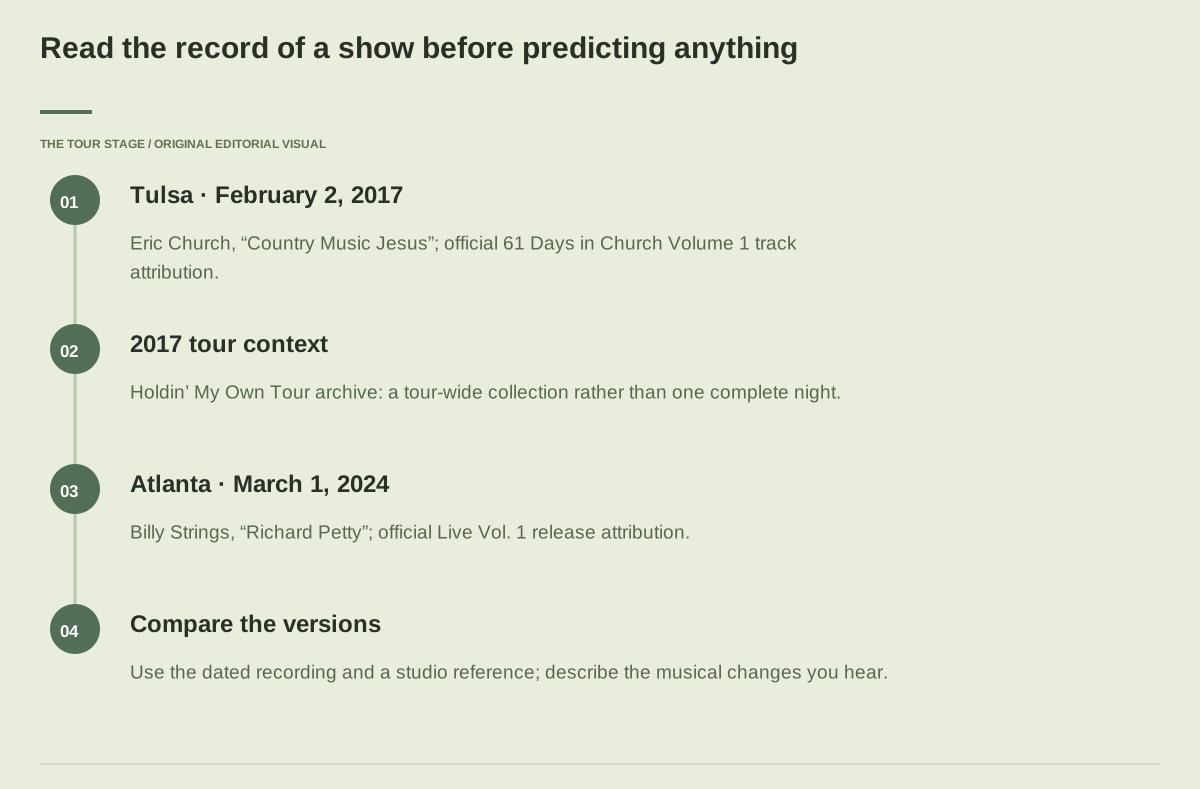
- Tulsa · February 2, 2017Eric Church, “Country Music Jesus”; official 61 Days in Church Volume 1 track attribution.
- 2017 tour contextHoldin’ My Own Tour archive: a tour-wide collection rather than one complete night.
- Atlanta · March 1, 2024Billy Strings, “Richard Petty”; official Live Vol. 1 release attribution.
- Compare the versionsUse the dated recording and a studio reference; describe the musical changes you hear.
Read the visual as text
- Tulsa · February 2, 2017Eric Church, “Country Music Jesus”; official 61 Days in Church Volume 1 track attribution.
- 2017 tour contextHoldin’ My Own Tour archive: a tour-wide collection rather than one complete night.
- Atlanta · March 1, 2024Billy Strings, “Richard Petty”; official Live Vol. 1 release attribution.
- Compare the versionsUse the dated recording and a studio reference; describe the musical changes you hear.
Billy Strings demonstrates why duration and transitions matter
Billy Strings’ official catalogue identifies Live Vol. 1 as his first live album.3 Its released track information includes “Richard Petty” recorded at Atlanta’s State Farm Arena on March 1, 2024.4 That dated entry is a reliable listening reference; the surrounding album is a curated release rather than a guarantee of one complete concert sequence.
Listen for the point where a song’s familiar structure opens into an instrumental conversation. The title on a setlist does not describe how long a break lasts, how one tune leads into another or which supporting instrument becomes the centre of attention. Compare the live recording with a studio version, then describe one actual change. “More energetic” is a start, but a shifted tempo, extended transition or different balance between voice and guitar tells you much more.
Read an album cycle as context for repertoire
A new album supplies an artist with different songs and textures to draw from. It also gives listeners a useful way to organise a large catalogue. Miranda Lambert’s Palomino, released in 2022, is documented by her label as a fifteen-song album following Wildcard and the collaborative Marfa Tapes period.5 These are distinct recording contexts, not interchangeable names for a set of hits.
When studying a historical Lambert list, mark which album supplied each song. This can reveal the relationship between a then-current record and older material without requiring a claim about the artist’s private intentions. A song’s inclusion may serve pacing, a musical contrast or an audience connection. Treat those as listening questions unless a direct source explains the decision. The album listening guide is a useful companion.
Make a three-column comparison
For each title, create three columns: the documented performance, the studio reference and what you hear changing. Put the date and venue in the first column, the album and version in the second, and a short musical observation in the third. Leave the observation blank until you have actually listened. A version label such as acoustic, live or radio edit can matter as much as the song name.
Start with only three songs. Choose a familiar single, a quieter performance and an unexpected catalogue selection. This gives the comparison a shape without turning preparation into homework. Note whether the band changes the opening, whether the vocal phrasing stretches and whether the ending closes firmly or leads onward. Those details help explain why a live performance can feel new even when the song has been in your library for years.
Medleys, covers and guests need careful labels
A crowd list may record a brief quotation as a full song, while a concert release may separate several connected pieces into individual tracks. Neither format tells the whole story on its own. When a title surprises you, check the recording or a reliable account before describing it as a complete cover. A guest appearance belongs to that documented occasion; it should not silently become part of an artist’s standard touring band.
Use your notes to distinguish an original, a full cover, a medley segment and an instrumental passage where the source supports the distinction. If the available evidence does not settle it, label the entry cautiously. This is especially helpful when preparing a discovery playlist for friends. They should know whether they are hearing the same version you encountered in the archive or a different artist’s studio recording chosen for background.
Build a listening queue without treating it as a prediction
A balanced queue can include songs from an artist’s newest album, older recordings that interest you and one official live example. This creates familiarity while leaving room for surprise. There is no need to reproduce an entire historical show before attending one. If the preparation starts to feel like a test, shorten the queue and focus on the songs that invite a second listen.
The opening-act guide adds another route: spend part of the journey with the support artists instead of using every minute on the headliner. When discussing plans, say that a track comes from a named past performance or record. That wording makes the provenance clear without making promises about a later night. Music discovery remains valuable even when the eventual set follows another path.
Keep a record of your own night afterwards
After the concert, write down the moments you remember before looking at a posted list. A transition, an instrumental solo or a shared chorus may matter more to your experience than the exact order. Then compare your memory with an attributed record of the show. If you contribute to a community database, follow its evidence and correction rules, and do not fill gaps simply because a song appeared at the previous stop.
Your notes can become a small listening map: a song to revisit, an older album to hear and a support artist worth following. The discovery calendar offers a way to extend that curiosity. A good setlist is an invitation back into the catalogue, while the live experience remains larger than the list of titles.
Sources & further reading
- Eric Church: 61 Days in Church tour context2017 touring format and live archive.
- Eric Church: Volume 1 official track listingTulsa February 2, 2017 recording attribution.
- Billy Strings: Live Vol. 1Official live album identity.
- Billy Strings official Live Vol. 1 release linkAtlanta March 1, 2024 track attribution.
- Sony Music: Miranda Lambert Palomino announcement2022 release and preceding recording projects.