
Compare the complete overnight routine
Start with two sentences: “After the final set, we will…” and “Before the first set, we will…”. Fill them in for both options. Camping might mean walking to a tent, finding a shower in the morning and buying breakfast on site. A hotel might mean leaving through a crowded exit, finding a shuttle, walking from a stop and returning before the next day’s programme. The accommodation label alone tells you little about the work involved.
Consider your own recovery needs. Some people sleep well outdoors after a long day; others struggle with light, temperature or neighbouring conversations. A private room may help, but only if travel does not consume the benefit. For a weekend focused on Cody Johnson, Riley Green or Old Dominion, your ability to enjoy the performance matters more than winning an argument about the “proper” festival experience.
Check what camping access actually buys
Camping products can separate the pitch, people, vehicle, power and admission. Read each product description with a checklist rather than assuming one purchase covers everything. Is a festival ticket required for every camper? Is the sleeping vehicle permitted? Can your group pitch together? Does the purchase describe a marked space or entry to a general field? Save the answers beside the booking confirmation so another person can understand them.
The Long Road’s current camping information distinguishes Pitch & Park from live-in vehicle arrangements. It prohibits sleeping inside a vehicle in Pitch & Park and directs sleeping-vehicle users to the appropriate live-in booking; its site was promoting the 2027 edition when checked on 8 November 2026.1 This is an example of why bringing a car is not the same permission as using it as your bedroom. Read the conditions for your specific purchase.
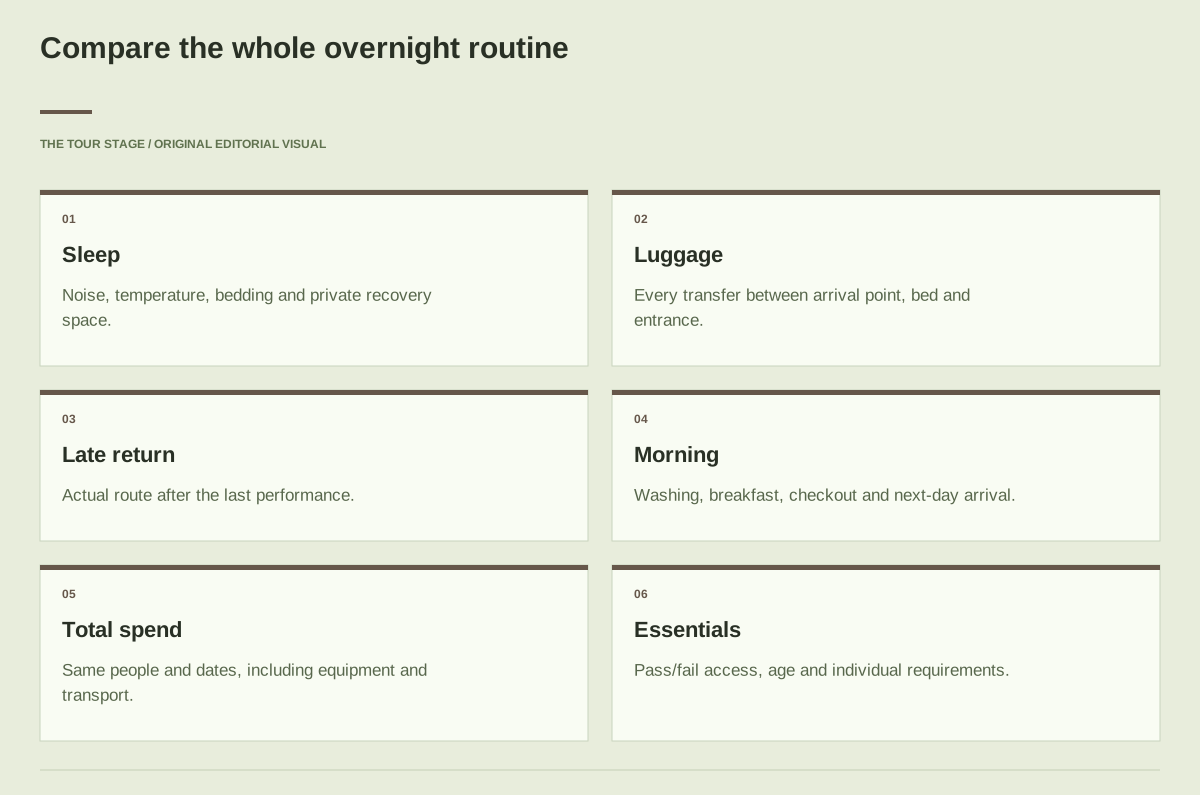
Compare the whole overnight routine
- SleepNoise, temperature, bedding and private recovery space.
- LuggageEvery transfer between arrival point, bed and entrance.
- Late returnActual route after the last performance.
- MorningWashing, breakfast, checkout and next-day arrival.
- Total spendSame people and dates, including equipment and transport.
- EssentialsPass/fail access, age and individual requirements.
Read the visual as text
- SleepNoise, temperature, bedding and private recovery space.
- LuggageEvery transfer between arrival point, bed and entrance.
- Late returnActual route after the last performance.
- MorningWashing, breakfast, checkout and next-day arrival.
- Total spendSame people and dates, including equipment and transport.
- EssentialsPass/fail access, age and individual requirements.
Turn a hotel location into a verified journey
A hotel described as near a festival may be close by road and awkward on foot. Trace the permitted route to the actual public entrance. Check whether it has pavements, lighting and a legitimate crossing of major roads. If you are using an official shuttle package, identify the precise stop and whether your chosen hotel is served. A hotel name in the same town does not establish shuttle access.
Stagecoach’s official hospitality FAQ says that, although the festival is all ages, partner hotels can impose age restrictions.2 This matters for a group whose lead guest is young, and for families arranging rooms across several bookings. Check the hotel’s own check-in age, occupancy, deposit and check-in hours before assuming the festival’s admission policy applies at reception. Keep the accommodation booking and festival pass as separate entries unless the package expressly includes both.
Count luggage movements rather than suitcase size
Camping needs a shelter and a sleep system before it needs decorative extras. Work out how every item gets from your arrival point to the pitch, and how it leaves when wet. A heavy cooler may be easy beside a car and impractical on a train. If equipment is shared, identify who brings the pegs, pump or other small component without which a larger item becomes useless. Test unfamiliar equipment at home.
A hotel reduces bulky camping gear but introduces different luggage problems. Can you leave bags before check-in or after checkout? Will the festival admit the bag you plan to carry that day? A hotel reservation does not create an exception to the arena’s permitted-item policy. The packing guide separates overnight equipment from entry-day essentials. Pack those categories independently so a delayed room or campsite arrival does not bury your tickets and medication.
Compare costs with the same group and dates
Make both estimates for identical people, arrival dates and departure dates. For camping, include the pitch or access products, equipment hire or purchases, transport, power where needed and food arrangements. For a hotel, include rooms for all required nights, taxes and fees, deposits, transport to the site and meals that are not included. Count breakfast only once. Do not assume cooking is permitted merely because you are camping.
The Stagecoach Resort page explicitly separates site products from festival admission and describes different camping categories.3 Treat these as different things to price, using the edition you intend to attend. A more useful comparison than “camping is cheaper” is “our quoted camping plan costs this much with the equipment we already own.” Enter both options separately in the budget worksheet, and put refundable holds in the cash-needed column rather than treating them as permanent expenditure.
Plan for the morning as carefully as the night
The next morning exposes weak accommodation choices. Consider washing, breakfast, charging devices and somewhere dry to organise clothes. Campers should decide what must be done before leaving the pitch and what can wait. Hotel guests should check whether checkout clashes with a morning departure or whether repeated shuttle trips are feasible. If you plan to work or study remotely during the weekend, verify the conditions you need rather than assuming reception or a communal socket will suffice.
Agree a realistic departure time with companions. A group sharing one tent does not need to share every set, but it does need a plan for keys, access and equipment. A group sharing a room should discuss late returns and alarms. Sleep preferences are a booking consideration, not a complaint to negotiate after everybody is tired. If priorities differ greatly, separate accommodation can preserve the friendship.
Use a weighted comparison that respects essentials
Give each factor an importance score from one to three: sleep, social atmosphere, equipment burden, weather resilience, journey simplicity and total estimated cost. Then describe each accommodation option in a sentence before assigning a score. The explanation is more valuable than a precise-looking total. “Twenty-minute walk on an official route” and “unconfirmed ride home” should not receive the same convenience score because both sound nearby.
Keep essentials outside the arithmetic. A required accessible bathroom, suitable medicine storage or enforceable minimum check-in age is a pass-or-fail question. A high total cannot repair a failed essential. Mark uncertain answers for follow-up, and do not reward an option because its problems have not yet been investigated. Ask someone else in the group to read the comparison for missing assumptions. This makes the worksheet a shared decision record rather than an argument dressed up as mathematics.
Make the booking reversible where it matters to you
Review cancellation, payment dates and what happens if a traveller cannot attend. Identify which reservations are linked and which remain payable independently. A festival change may not automatically cancel your room, transport or equipment hire. Read those individual terms and decide how much money you are willing to commit at each stage. Do not use a low headline price to justify a risk that would make the trip uncomfortable.
Once you choose, write a short operating plan: arrival point, lead booker, access credentials, overnight address or campsite category, and morning departure. Give every traveller the details they need. Keep one version of the plan with a clear update date, then return attention to the music. The group-planning system helps coordinate people without forcing everybody into the same daily routine.
Sources & further reading
- The Long Road camping, live-in and Pitch & Park informationCurrent 2027 sales-cycle categories and sleeping-vehicle restriction; checked 8 November 2026.
- Stagecoach enhanced-experience FAQ2027 hospitality FAQ distinguishes all-ages festival admission from partner hotel age restrictions.
- Stagecoach Resort informationCamping product categories and separate festival admission; checked 8 November 2026.