
Start at the end of the final evening
Write down where you need to sleep and the latest reliable way of getting there. Work backwards from the last usable departure, adding the time needed to leave the viewing area, walk to the authorised stop and board. A train reaching the nearest town in the afternoon is not a complete transport plan if the last bus leaves before the headline set. Decide whether you are willing to leave music early before buying the ticket.
For a trip built around Dan + Shay, Kelsea Ballerini or Jordan Davis, check the real performance day and expected finish rather than using the festival’s broad opening hours. The clash-planning guide can help protect that final departure as firmly as an anchor set. Keep a viable alternative if your preferred service is missed.
Distinguish an official shuttle from a normal bus
A festival shuttle may serve selected hotels, park-and-ride sites or local collection points. It can have its own pass, timetable and boarding rules. A regular public bus follows the transit operator’s arrangements, which may change for weekends, holidays or road closures. Neither word guarantees service to the entrance you need. Read both directions, the precise stop and any limit on luggage or mobility equipment.
Stagecoach’s current getting-here page, in the 2027 sales cycle when checked on 8 November 2026, describes round-trip Valley shuttles and says return service ends sixty minutes after the music.1 That is a specific organiser arrangement, not a general rule for festivals. Check its current map and eligible stop before booking a room. If a shuttle pass is separate, include it in the trip cost and keep its credential available independently of your admission ticket.
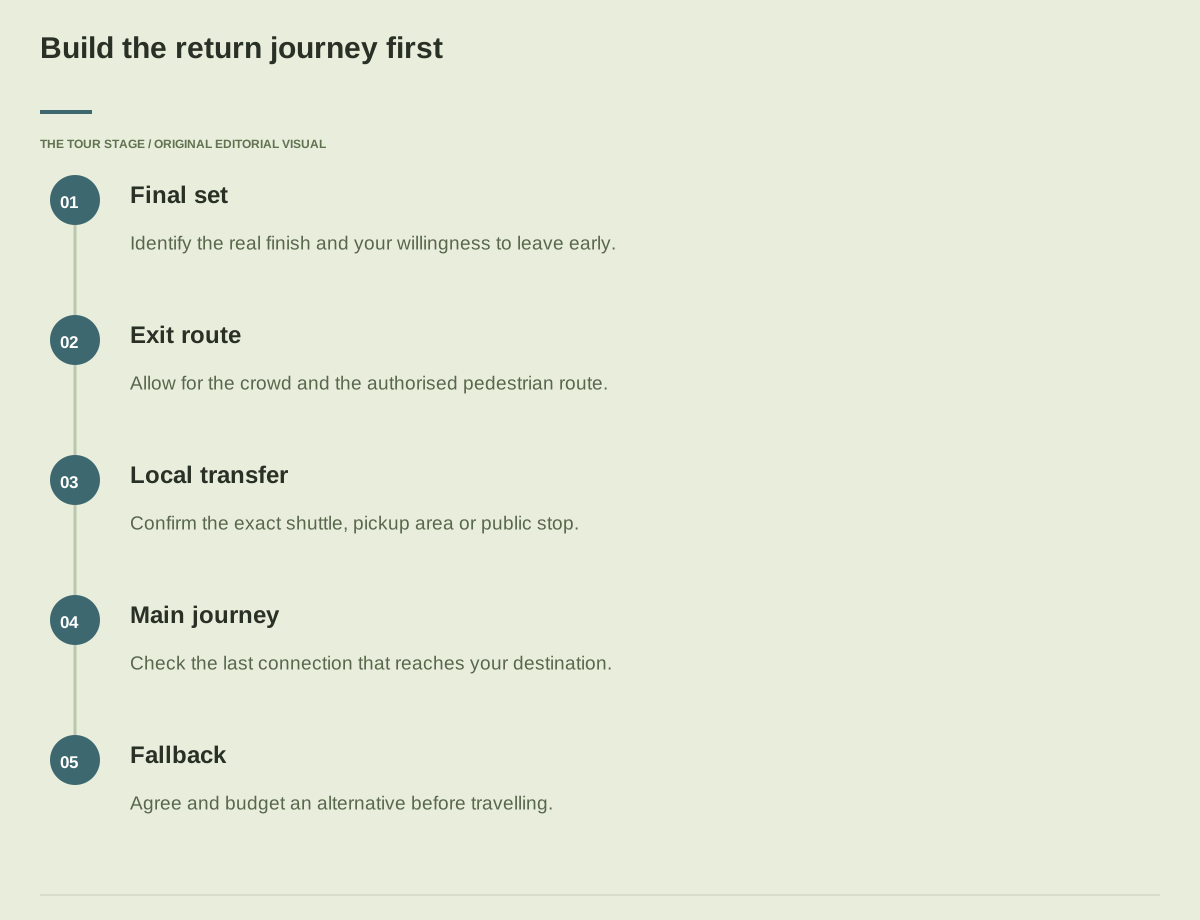
Build the return journey first
- Final setIdentify the real finish and your willingness to leave early.
- Exit routeAllow for the crowd and the authorised pedestrian route.
- Local transferConfirm the exact shuttle, pickup area or public stop.
- Main journeyCheck the last connection that reaches your destination.
- FallbackAgree and budget an alternative before travelling.
Read the visual as text
- Final setIdentify the real finish and your willingness to leave early.
- Exit routeAllow for the crowd and the authorised pedestrian route.
- Local transferConfirm the exact shuttle, pickup area or public stop.
- Main journeyCheck the last connection that reaches your destination.
- FallbackAgree and budget an alternative before travelling.
A documented city example: Nashville’s special train
WeGo’s official CMA Fest Express page describes a special train on Saturday 6 June 2026 between Lebanon and downtown Nashville. It required a separate event ticket, did not accept ordinary weekday or monthly Star products, and used a wristband for the return journey.2 This is a past-edition example of why a familiar transport system can use unfamiliar arrangements during a festival.
Do not carry those dates or terms into a later visit. The practical lesson is to ask whether the service is regular, specially ticketed or limited to one day. Check where it arrives relative to your stage and whether the return follows an advertised clock time or the end of a particular concert. Save the operator’s own instructions. A broad city-transport guide can help identify options, but the operator should confirm the service you actually intend to board.
A rural example: the station is only part of the journey
Rural festivals need a separate plan between the nearest rail station and the grounds. The remaining distance may be too long, lack a legal pedestrian route or require a booked taxi. Search the organiser’s travel page for an official transfer, then verify it for your arrival day. If none is offered, ask a licensed operator about the exact pickup and return arrangements. Do not interpret the presence of a railway line on a map as practical festival access.
Maverick’s official location information provides travel guidance for its Easton Farm Park setting in Suffolk and points rail travellers to National Rail.3 Use the organiser’s location to identify the destination accurately, then check every connection. The final rural leg deserves its own time allowance and budget entry. The budget calculator can keep that group transport amount visible instead of letting it disappear inside the main rail fare.
Verify public transport for the exact date and direction
Use the transport agency or national rail planner to select the actual outward and return dates. National Rail’s official guide explains date and time selection and shows that results identify changes and replacement transport.4 Read the whole itinerary. A journey involving a replacement bus may have different luggage, accessibility or connection implications from the train you expected.
Check the final service that reaches your destination, not merely the last vehicle departing the nearest station. One missed connection can strand you at an interchange. Note when booking opens and check again close to departure for engineering work or disruption. Screenshot the planned itinerary, while remembering that a saved image will not update. Keep the operator’s live information available when travelling, and put the station names in your notes rather than relying on an easily confused abbreviation.
Use the authorised pickup point
A rideshare app can locate a driver, but the festival controls which roads and collection zones can be used. Read the official route from the gate to the pickup area and follow signs on site. The closest visible road may be closed, unsafe or reserved for another purpose. If a friend collects you, send the organiser’s approved location rather than dropping a pin where you happen to be standing.
Stagecoach publishes different areas for rideshare and friends-and-family pickup and restricts pedestrian access on certain surrounding road sections.1 That distinction shows why collection instructions need more than a street address. For your own event, identify which category applies and whether the route changes late at night. Share the plan before reception becomes busy, and agree what the driver should do if you cannot communicate immediately.
Plan luggage and accessibility across every transfer
List what you will be carrying at each stage. A weekend backpack and a tent can be manageable on a direct train and difficult through several crowded connections. Check station lifts, transfer distances and the actual vehicle’s arrangements when relevant. Contact the service provider about assistance using the specific journey, and ask the festival separately about the route from its transport stop to the entrance.
Accommodation can solve or create a luggage gap. Confirm whether a hotel will hold bags before check-in and after checkout. Campers should identify where unloading ends and the walk to the pitch begins. The packing guide separates things needed at the entrance from overnight equipment. Keep travel documents, admission details and essential personal items reachable even if larger bags are being stored or carried by someone else.
Write a one-page transport plan
Record the outward service, interchange, final transfer, accommodation address, return stop, last usable departure and fallback. Add the relevant ticket or booking references and the date you verified the details. Name the person responsible for each shared reservation. If the group splits for music, agree when everyone needs to start moving towards the return transport. Do not wait until the final encore to negotiate it.
Build reasonable spare time into important connections and keep enough resources for the alternative you have chosen. If no reliable return exists, change the accommodation or the day you attend before committing to an impractical trip. A well-researched car-free plan can make a weekend feel simple because the difficult questions have already been answered, leaving you free to spend the day thinking about performances instead of the journey home.
Sources & further reading
- Stagecoach getting here and parkingCurrent 2027 sales-cycle shuttle return window, separate collection zones and pedestrian restrictions; checked 8 November 2026.
- WeGo Star CMA Fest Express 2026Past special train on 6 June 2026 with event-specific ticket and return-wristband rules.
- Maverick Festival locationOfficial Easton Farm Park destination and rail-travel guidance; no last-mile service is assumed.
- National Rail journey-planner guideDate, time and connection information including replacement transport in itinerary results.