One instrument, several musical jobs
Fiddle and violin usually name the same basic instrument, with the choice of word often signalling a musical tradition rather than a different machine. The four strings, fingerboard, bridge and bow do not dictate a single style. What matters is how a musician shapes rhythm, pitch and interaction. In country music, the same instrument can sound earthy and percussive in one passage, sustained and almost vocal in another.
Before identifying a genre, identify a job. Does the fiddle state a repeating melody that dancers can anticipate? Does it answer the singer? Is it holding harmony while another instrument takes a break? Those questions stop “fiddle music” becoming an unhelpfully broad label. They also explain why two bands with similar instruments can feel so different: the distribution of attention and rhythmic responsibility changes the listening experience.
The bow supplies rhythm as well as pitch
A bow makes sound by moving across the strings, but the musical effect depends on more than direction. A player can connect several notes in one bow movement or give individual notes separate attacks. Changing pressure, speed and contact point affects the result. A short, accented stroke can act like a rhythmic syllable; a connected line can carry a melody across the beat.
Our illustration is therefore a guide to actions, not a transcription of a famous solo. Down-bow and up-bow arrows describe direction, not automatically loud and soft notes. A diagram that assigns every down-bow to a strong beat would teach a rule real musicians regularly vary. Listen for the start of each sound and the length of the space after it. Those small details help the fiddle work with guitar and bass instead of merely floating above them.
Three fiddle roles to hear
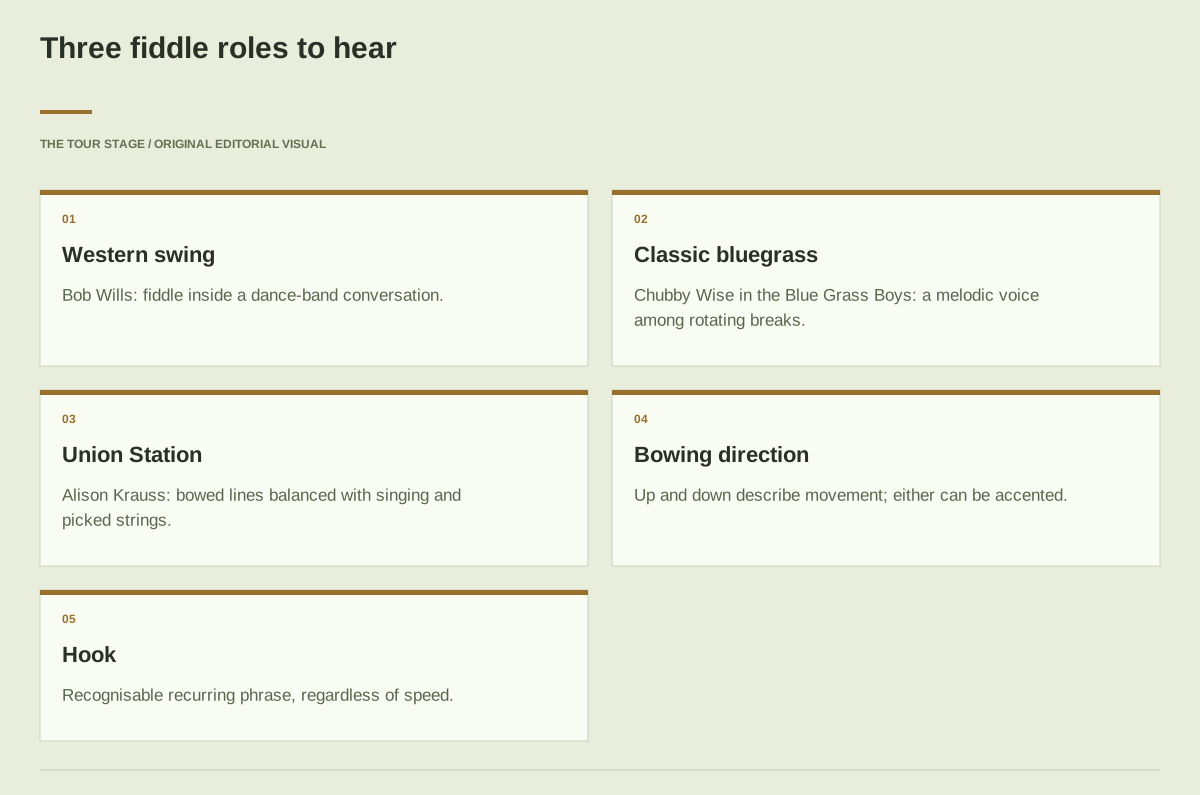
- Western swingBob Wills: fiddle inside a dance-band conversation.
- Classic bluegrassChubby Wise in the Blue Grass Boys: a melodic voice among rotating breaks.
- Union StationAlison Krauss: bowed lines balanced with singing and picked strings.
- Bowing directionUp and down describe movement; either can be accented.
- HookRecognisable recurring phrase, regardless of speed.
Read the visual as text
- Western swingBob Wills: fiddle inside a dance-band conversation.
- Classic bluegrassChubby Wise in the Blue Grass Boys: a melodic voice among rotating breaks.
- Union StationAlison Krauss: bowed lines balanced with singing and picked strings.
- Bowing directionUp and down describe movement; either can be accented.
- HookRecognisable recurring phrase, regardless of speed.
Western swing: a voice inside a larger band
Bob Wills is the clearest historical doorway into fiddle-led western swing. The Country Music Hall of Fame identifies him as both fiddler and bandleader, and describes the style’s mixture of fiddle traditions, jazz, blues and dance music.1 The important listening lesson is that a fiddle can belong to a broad rhythmic conversation, not only a small acoustic string band.
Start with “Faded Love” and “San Antonio Rose” in documented Wills recordings. Notice when the melody feels smooth, when an accent creates lift and when a response seems to invite the next instrumental voice. These are editorial listening prompts, not claims that every release bearing those titles uses an identical arrangement. Wills recorded across different years and ensembles. Check the version before comparing a solo or naming everyone on the session; a familiar song title is not a complete personnel credit.
Bluegrass: melody passed from player to player
The National Endowment for the Arts identifies Chubby Wise as the fiddler in the classic mid-1940s Blue Grass Boys lineup alongside Bill Monroe, Lester Flatt, Earl Scruggs and Howard Watts.2 That concrete ensemble is a better starting point than saying bluegrass simply means fast fiddle. The instrumental roles fit together: a break foregrounds one player while the others maintain a supporting pattern.
Listen to a complete band performance and follow the handover. The fiddle may repeat a recognisable piece of the tune, vary it, then leave room for banjo or mandolin. Listen underneath the solo as well. The accompaniment should make the foreground intelligible. If you enjoy Sierra Hull, use her mandolin playing as a second reference point: the mandolin guide explains how another treble instrument can exchange rhythmic and melodic duties with a fiddle.
Alison Krauss: restraint changes the foreground
Alison Krauss is both singer and fiddler, an important distinction when talking about Union Station. Concord’s account of Paper Airplane identifies the ensemble’s own production role and supplies context for hearing it as a band record.3 Rather than assume that every beautiful high sound is fiddle, listen to the attack: bowed fiddle and picked resonator guitar have different ways of beginning a note.
Try the title track, then an instrumental passage elsewhere in the album. Hear how a melody can make an impression without filling every gap. Our interpretation centres on space: the fiddle’s presence can be felt through a response, a change of register or a held tone. It need not dominate the whole arrangement to matter. The singer’s name on the cover should not erase the other musicians, and a member’s instrument list should not be treated as proof that the instrument appears on every track.
From a recurring phrase to a modern hook
A hook is the piece you remember and recognise on return. A fiddle hook may appear before the first vocal, between choruses or only after a lyric has established the song’s identity. Its importance comes from placement and recurrence as much as technical difficulty. A short phrase can be more decisive than a long solo because it becomes the listener’s orientation point.
When exploring Kin Faux or other fiddle-forward contemporary bands, notice whether the fiddle is an equal band voice or an occasional colour. Start with an official performance so that the instrument is visible, then check the relevant release credits. Avoid reading genre identity directly from the presence of a bow. Electric amplification, a rock backbeat and vocal production can all change how a fiddle phrase functions without making its player less connected to country traditions.
A comparison that does not become a ranking
Put a Wills recording, a Blue Grass Boys performance and a Union Station track in a short listening queue. For each, write one sentence about pulse, one about the fiddle’s foreground time and one about its relationship to singing. Keep the descriptions concrete: repeated figure, held response, shared melody, short accented strokes. “More traditional” is too vague to tell another listener what to hear.
The result should be a set of differences, not a winner. Western swing can make the instrument part of a dance orchestra; bluegrass can showcase rapid exchanges; a quieter country arrangement can use it as a second expressive voice. Each context rewards a different kind of attention. Continue with bluegrass versus country or country harmonies to hear how instrumental and vocal arrangements solve the same problem: letting several musical lines belong to one song.
Sources & further reading
- Country Music Hall of Fame: Bob WillsWills as fiddler and western-swing bandleader.
- National Endowment for the Arts: Bill MonroeClassic Blue Grass Boys ensemble and instrumental roles.
- Concord: Alison Krauss & Union StationPaper Airplane personnel, production and ensemble context.