A room can shape a musical language
Honky-tonk music is closely associated with places where people gathered to drink, dance and hear a band. That setting helps explain the value of a clear pulse and a singer who can establish a situation quickly. It does not mean every recording is an account of a bar, or that every bar featuring country music represents the same historical tradition. The room supplies conditions; musicians turn them into a style.
Ernest Tubb provides a documented early anchor. The Country Music Hall of Fame describes his spare honky-tonk approach and electric lead guitar, and identifies “Walking the Floor Over You” as his major 1941 breakthrough. Notice how little a performance needs to establish a recognisable personality. The voice need not be smooth, and the band need not be crowded. Directness can be a highly specific artistic choice.1
The beat and the feeling need not agree
One of honky-tonk’s enduring pleasures is the tension between a danceable band and an unsettled speaker. A steady rhythm can carry disappointment, jealousy or resignation. This is not a contradiction to solve. The listener can move with the music while hearing that the narrator cannot move on. An energetic surface may make the emotional predicament more pointed rather than disguising it.
Listen for what the singer does against that foundation. A delayed entrance can sound weary; a briskly delivered line can sound defensive. The band may answer with a short bright figure, leaving the singer’s problem unresolved. It is useful to hear the arrangement as a social environment around the character. A room full of motion continues while one person remains preoccupied. That interpretation works without assuming the lyric is the performer’s autobiography.
Two separate rhythm questions
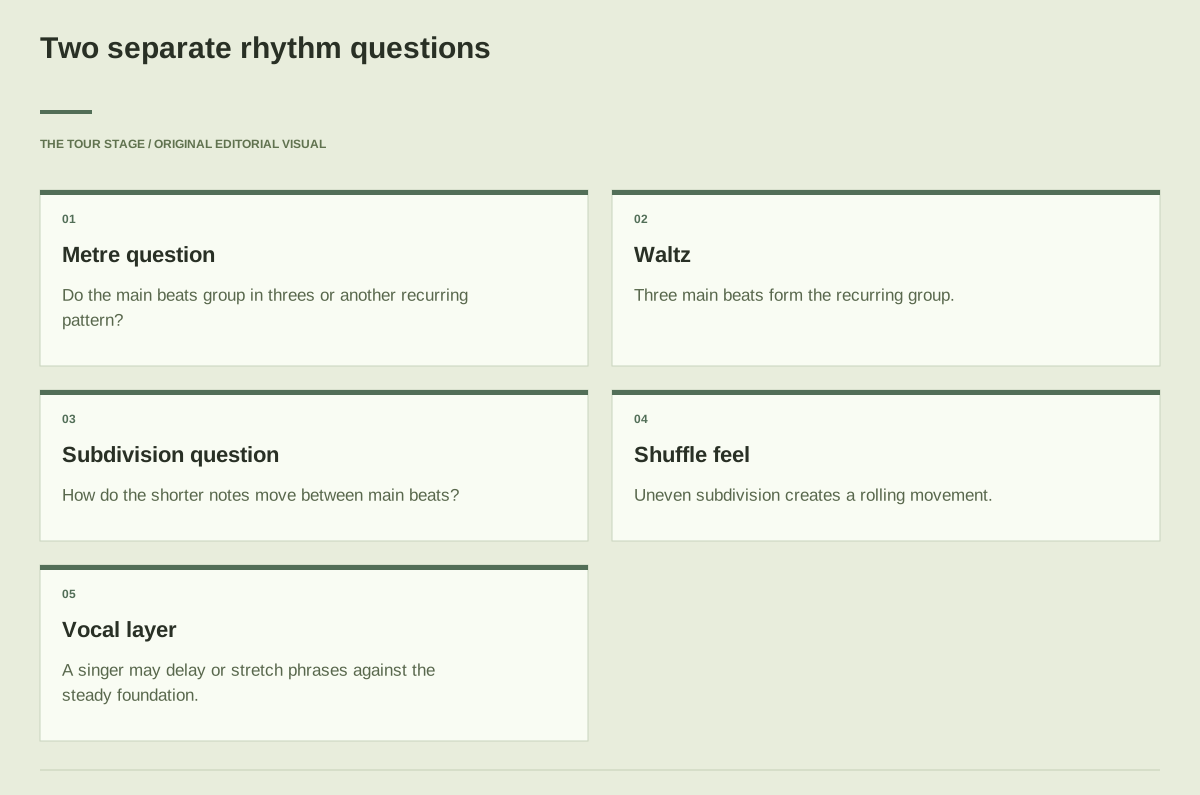
- Metre questionDo the main beats group in threes or another recurring pattern?
- WaltzThree main beats form the recurring group.
- Subdivision questionHow do the shorter notes move between main beats?
- Shuffle feelUneven subdivision creates a rolling movement.
- Vocal layerA singer may delay or stretch phrases against the steady foundation.
Read the visual as text
- Metre questionDo the main beats group in threes or another recurring pattern?
- WaltzThree main beats form the recurring group.
- Subdivision questionHow do the shorter notes move between main beats?
- Shuffle feelUneven subdivision creates a rolling movement.
- Vocal layerA singer may delay or stretch phrases against the steady foundation.
Shuffle and waltz are different kinds of motion
A shuffle divides the beat with a rolling, uneven feel. A waltz groups the main beats in threes. Those descriptions concern different musical features: subdivision in the first case, metre in the second. Calling them opposites would be misleading. For a beginner, count a steady pulse first, then listen for its grouping and the shorter notes moving between beats. A slow tempo does not settle either question.
The accompanying graphic therefore separates “how beats group” from “how the space between beats feels.” It is a listening aid, not a transcription of a particular song. Try tapping softly on each main beat, then humming the bass movement. If the vocal stretches a line, keep your pulse going underneath it. This makes the singer’s freedom more audible. Our neotraditional guide follows the same dance vocabulary into newer recordings.
Mark Chesnutt makes understatement expressive
Mark Chesnutt’s “Too Cold at Home” is a useful close-listening choice. The official recording credits identify Bobby Lamoyne Harden as songwriter and Mark Wright as producer on the MCA recording. Establishing those roles matters: the singer’s creative contribution lies in interpretation, while the written song and the recording’s production have their own credited makers.2
Listen for how a seemingly conversational delivery handles the hook. Does the voice push it toward a joke, expose its pain or allow both readings to coexist? Then concentrate on the instrumental space after the phrase. A band can acknowledge a singer without underlining every emotion. Honky-tonk’s apparent plainness often comes from this economy: a clear situation, a memorable melodic turn and enough room for a listener to recognise the feeling without being told how strongly to react.
Jake Worthington keeps the ensemble in view
Jake Worthington’s self-titled 2023 debut gives a newer point of comparison. His official release material names “State You Left Me In” and “Next New Thing,” and foregrounds fiddle, steel, piano and shuffling rhythms. Start with one of those tracks and follow the instrumental replies rather than only the size of his voice. The band’s coordination is part of the performance’s character.3
A deep, emphatic vocal can still leave vulnerable space. Listen for the moment a held note relaxes or an instrumental response takes over. Then compare Chesnutt and Worthington at a similar listening level. Avoid ranking their traditionalism by accent or volume. They provide different examples of how a singer can be central without making every other musician disappear. That relationship is more informative than a checklist of what a honky-tonk artist ought to look like.
Wynn Williams connects the vocabulary to another generation
Wynn Williams’ official biography identifies his 2020 self-titled album and the later Country Therapy project, including “Denver to Dallas” and “Here for the Beer.” Those are concrete catalogue routes into a contemporary artist who draws on a recognisable country band vocabulary. Use the titles to locate official recordings, then ask which musical gestures make the connection audible to you.4
A familiar subject does not guarantee a familiar arrangement. A drinking song can be brisk, reflective, comic or uneasy; the singer’s phrasing and the band’s pulse determine how the scene feels. Compare a chorus with its preceding verse. Does the rhythm change, or do added voices and stronger instrumental attacks create the lift? Honky-tonk remains adaptable because its basic ingredients can be balanced differently, even when a listener recognises the room the record seems to evoke.
Hear the room without turning this into a nightlife directory
Historic dance halls such as Gruene help explain how a social space and a repertoire reinforce each other. The hall’s operator dates the building to 1878 and documents its long connection with live artists. That history is context for listening; it should not be confused with a current promise about seating, dancing or the atmosphere at a particular show. A venue’s present event information answers those practical questions.5
Follow the Texas-country ecosystem for the relationship between rooms, releases and regional radio, or the ballad guide for expressive restraint. For this session, choose Tubb, Chesnutt, Worthington and Williams, then write one note about the pulse and one about the singer’s relationship to it. The lasting connection is not merely neon, boots or a barroom noun. It is the musical balance between shared movement and individual feeling, and the many ways a band can make that balance persuasive.
Sources & further reading
- Country Music Hall of Fame: Ernest Tubb1941 breakthrough and spare electric-guitar honky-tonk style.
- Mark Chesnutt official recording creditsUMG-supplied writer, producer and recording credit.
- Jake Worthington official news archive2023 songs and instrumental vocabulary.
- Wynn Williams official biography2020 album and Country Therapy selections.
- Gruene Hall operator history1878 hall and live-music associations.