
Start with the edition and the ticketed days
Before exploring a name, identify the year, dates, location and whether the poster separates days. A familiar logo can make an archived bill look current at a glance. Stagecoach’s official festival-history page retains posters by year, including the 2026 bill, making it a useful example of a legitimate archive that should not be mistaken for a fresh announcement.1 Save the edition label alongside any image you share with friends.
Next, compare the poster with the ticket description. Does your pass cover the day shown? Are separately ticketed performances clearly distinguished? A weekend artist list may not yet assign individual days. If the date of your favourite act is essential, look for a dated organiser announcement or schedule rather than inferring it from the order in which names appear. The first-festival guide helps connect the bill to the type of trip you want.
What a headliner position can and cannot tell you
Large type gives an artist prominence in the organiser’s marketing. It can tell you which names anchor the public identity of that edition. It does not, by itself, establish the exact start time, set length, stage, production or songs you will hear. Those details require a schedule or a more specific announcement. The word “headliner” is therefore useful as a billing description, but it should not carry every logistical assumption you attach to an evening concert.
Do not read smaller lettering as lower quality. A lower-billed act may play a quieter room, suit a specialist audience or be unfamiliar to you for reasons unrelated to its musical achievements. Rather than trying to prove that the undercard is secretly superior, let different positions do different jobs in your planning. A recognised anchor can make the trip appealing; an unfamiliar name can give the day a reason to begin earlier.
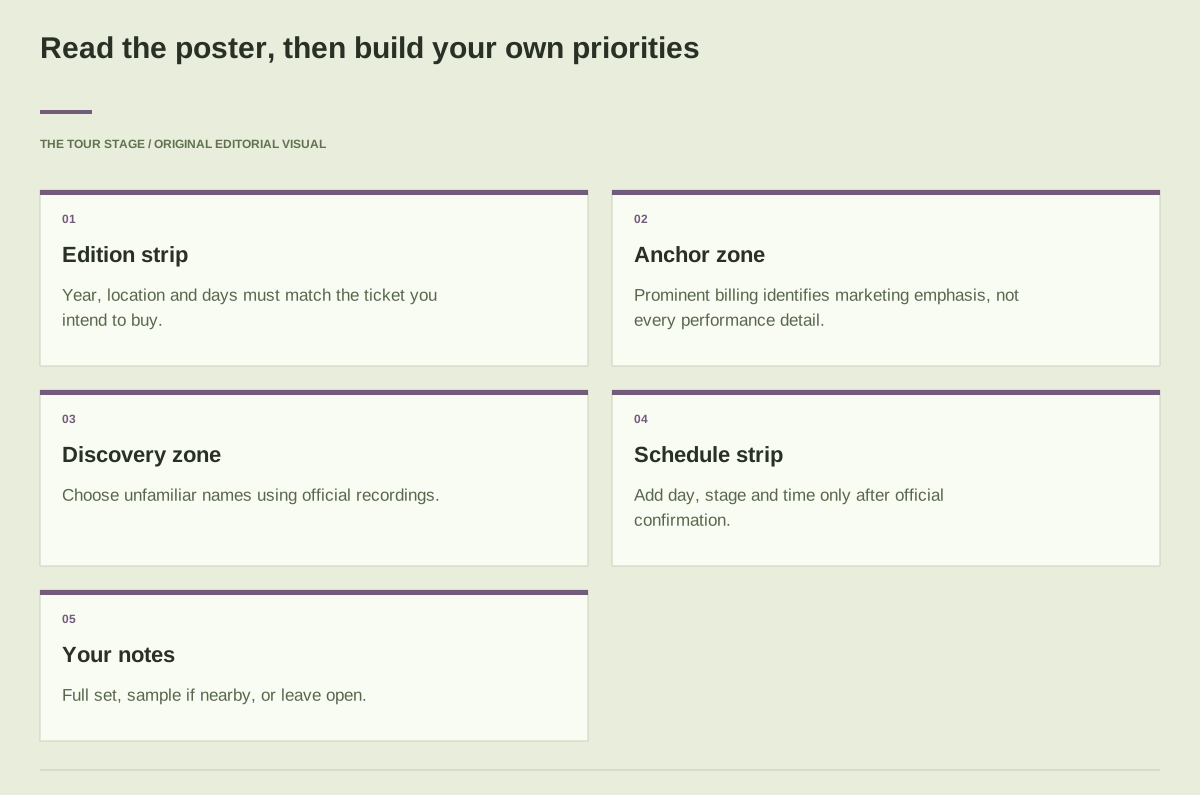
Read the poster, then build your own priorities
- Edition stripYear, location and days must match the ticket you intend to buy.
- Anchor zoneProminent billing identifies marketing emphasis, not every performance detail.
- Discovery zoneChoose unfamiliar names using official recordings.
- Schedule stripAdd day, stage and time only after official confirmation.
- Your notesFull set, sample if nearby, or leave open.
Read the visual as text
- Edition stripYear, location and days must match the ticket you intend to buy.
- Anchor zoneProminent billing identifies marketing emphasis, not every performance detail.
- Discovery zoneChoose unfamiliar names using official recordings.
- Schedule stripAdd day, stage and time only after official confirmation.
- Your notesFull set, sample if nearby, or leave open.
Treat the undercard as a set of listening invitations
Circle a small number of unfamiliar names across the poster instead of adding every act to a playlist. Choose some near artists you already like and at least one whose style you cannot predict. This keeps discovery broad without making preparation a second job. Write down your initial question for each artist: close harmony, guitar sound, songwriting perspective or live energy. You are looking for a reason to listen attentively.
A practical starting trio is Tucker Wetmore, Carter Faith and The Castellows, used here as listening examples rather than as a claim about a shared current lineup. Tucker Wetmore’s official shop lists “Wind Up Missin’ You”; Carter Faith’s music page lists recordings including “Cowboy Forever”; The Castellows’ official site links acoustic performances and recorded releases.234 Begin with the artists’ own links so you know whose recording you have found.
Use a three-listen method for unfamiliar acts
First, listen to one official studio recording all the way through. Notice the voice, rhythmic feel and instruments that shape its identity. Second, try a contrasting recording: a quieter song after an energetic one, or a fuller production after an acoustic performance. Third, watch an official live or acoustic video when available. It can help you form questions about the stage performance without promising the same band, arrangement or setlist at your festival.
Make a short note after each artist: “want a full set,” “sample if nearby” or “not a priority for this trip.” These are preferences, not verdicts. If you remain undecided, leave the act as an open possibility rather than forcing an artificial score. Keep one listening link in the group plan. A specific song is easier for friends to discuss than an unexplained claim that a band is “a must-see.”
Read stage identities after the schedule arrives
A poster can mix bluegrass, mainstream country, soul, rock and songwriters under one event identity. The eventual stage programme may reveal useful clusters, but a stage name alone does not prove a fixed genre policy. Read the actual acts and times. If you like the sound of several consecutive artists on one stage, staying put can produce a more satisfying afternoon than repeatedly crossing the grounds for bigger names.
MerleFest’s published 2026 schedule demonstrates a multi-stage format in which named performances and times are available separately from the general bill.5 That historical structure illustrates why the schedule is the next document to read. It does not predict another edition’s placements. Use the clash planner once you have verified timings, and give any unfamiliar artist you prioritise enough time to make an impression.
Understand additions, substitutions and special wording
Read the small text attached to a performance. An acoustic set, a songwriter round, a tribute programme and a full-band show describe different formats. “Featuring” may identify a guest within a project rather than a second complete set. An appearance across several days may mean more than one performance, but confirm each one instead of assuming identical programmes. If a collaboration is the reason you are booking, seek explicit confirmation from the organiser.
Keep the official artist list and current schedule as your reference when a shared image differs from the website. Posters travel through social media long after an update. Save the date of any announcement you rely on and review the event’s change and refund terms independently. A musical wish is a good reason to investigate a festival; it is not evidence that a particular guest, duet or song has been promised.
Make an original annotated poster for your own planning
Use a simple three-zone sketch: anchors at the top, discovery choices in the middle and unresolved questions at the bottom. Write your reasons beside the names rather than reproducing the organiser’s hierarchy. Add a separate strip for confirmed day and stage information once available. This distinguishes a personal priority list from an official promotional design and makes it easier to explain your choices to companions.
The graphic accompanying this article uses those zones without inventing a real bill. A large anchor box means “I want to build around this set,” not “the artist is better.” A discovery box means “I have listened and want to investigate,” not “the artist is new.” Share the version with the fewest necessary notes. The group guide helps turn different preferences into a workable weekend without making everyone follow the same route.
Arrive with curiosity still available
Preparation should help you notice what is happening, not eliminate surprise. Leave a gap near a smaller stage, arrive before a set begins and listen for longer than a chorus before deciding to move. If a friend recommends something unexpected, you already have enough structure to decide what you would give up. Discovery is more enjoyable when the tradeoff is conscious.
After the festival, return to the artists you enjoyed and follow their official music links. Your notes can become a listening route rather than a list of names you ticked off. A festival bill has done its most useful work when it connects you with music that lasts beyond the weekend, whether that began with the largest name on the poster or a line you nearly overlooked.
Sources & further reading
- Stagecoach festival-history archiveOfficial year-labelled posters, including 2026; supports the archive/current-edition distinction.
- Tucker Wetmore official music shopLists Wind Up Missin’ You as an official music product.
- Carter Faith official music catalogueOfficial listening links including Cowboy Forever; no shared festival billing implied.
- The Castellows official websiteOfficial recordings and acoustic/live performance links.
- MerleFest 2026 printable scheduleHistorical example of detailed stage/time information separate from a general lineup.