
Read a credit as a description of work
A writing credit identifies authorship of a composition. A vocal credit identifies participation in a particular recording. A production credit concerns the making of that recording; publishing and master-recording rights are different again. These roles often overlap, but a listener should not collapse them into one idea of ownership. The distinction becomes especially important in a duet, where a featured singer may have written none of the song, or where one of the writers is a famous performer absent from the recording. Credits provide an answer to who did what, not a complete explanation of how an idea developed. The working songwriter guide follows that next question. Begin with the release and version, since an acoustic remake and a later duet are separate performances.
George Strait: selecting a point of view
George Strait is a useful starting point for hearing the creative force of an interpreter. The Country Music Hall of Fame’s account follows a career built around a distinctive traditional approach and successful song selection.1 On “Amarillo by Morning,” consider the emotional effect of his measured delivery. The performance does not ask for sympathy by increasing its intensity at every opportunity. Its authority grows from steadiness: the narrator appears able to carry disappointment and continue. An interpreter chooses which feelings to foreground and which to leave unresolved. Compare that balance with the emotional directness of “I Cross My Heart.” Different songs require different proportions of warmth, reserve and emphasis. None of that work becomes automatic when another person supplies a composition.
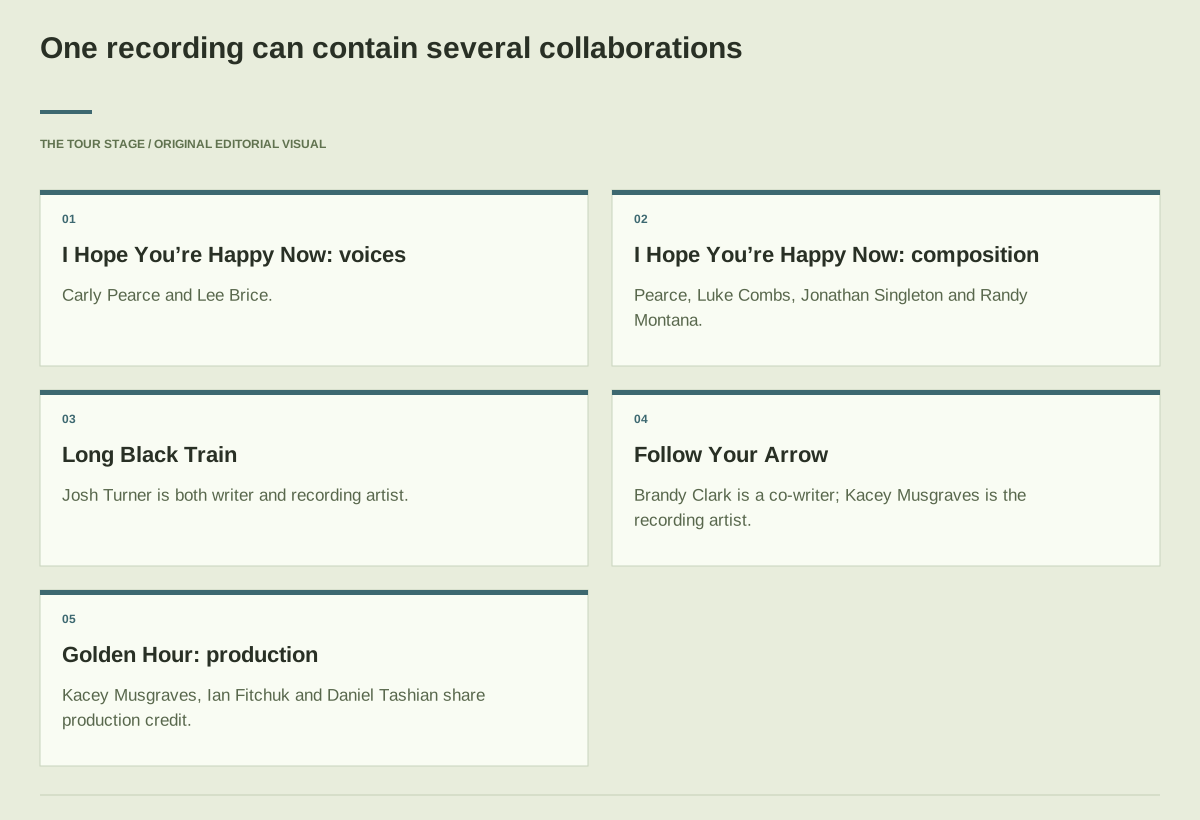
One recording can contain several collaborations
- I Hope You’re Happy Now: voicesCarly Pearce and Lee Brice.
- I Hope You’re Happy Now: compositionPearce, Luke Combs, Jonathan Singleton and Randy Montana.
- Long Black TrainJosh Turner is both writer and recording artist.
- Follow Your ArrowBrandy Clark is a co-writer; Kacey Musgraves is the recording artist.
- Golden Hour: productionKacey Musgraves, Ian Fitchuk and Daniel Tashian share production credit.
Read the visual as text
- I Hope You’re Happy Now: voicesCarly Pearce and Lee Brice.
- I Hope You’re Happy Now: compositionPearce, Luke Combs, Jonathan Singleton and Randy Montana.
- Long Black TrainJosh Turner is both writer and recording artist.
- Follow Your ArrowBrandy Clark is a co-writer; Kacey Musgraves is the recording artist.
- Golden Hour: productionKacey Musgraves, Ian Fitchuk and Daniel Tashian share production credit.
Brandy Clark: the same writer in different settings
Brandy Clark has written for other performers as well as making her own records. Her official biography names Kacey Musgraves’ “Follow Your Arrow” and Miranda Lambert’s “Mama’s Broken Heart” among her outside writing credits.2 That provides a listening route through the difference between an author’s catalogue and a singer’s catalogue. Start with Clark’s own “Stripes,” then compare the attitude and pace of a Lambert performance without presuming that both narrators represent Clark personally. A songwriter can create a character whose decisions differ from their own. Equally, an artist can recognise a song’s dramatic usefulness without presenting it as a documentary confession. The strongest analysis explains the character and performance before making claims about a writer’s private life.
Carly Pearce: a writer sings one side of a duet
“I Hope You’re Happy Now” was written by Carly Pearce, Luke Combs, Jonathan Singleton and Randy Montana; its released duet pairs Pearce with Lee Brice. The issuing label’s announcement separates these roles explicitly.3 This is a compact example of why visible performers are not the complete writing team. Listen for the way the two vocal perspectives change the listener’s understanding of the breakup. One voice establishes a situation; the other gives its consequence a different emotional weight. The song is not simply sung twice at different pitches. Its performance distributes responsibility and regret between people. Read the credit again afterwards: it maps a collaboration behind the composition, while the duet itself creates another collaboration at the microphone.
Josh Turner: one artist can use both models
Josh Turner wrote “Long Black Train”; his label’s greatest-hits announcement identifies it as self-penned.4 The recording places his low voice at the centre of a moral and musical journey. Its recurring images and rhythmic motion are especially useful for hearing the relationship between a song’s concept and its arrangement. Turner’s authorship of this song does not mean every song he records must follow the same model. An artist can write one selection, co-write another and choose a third from outside writers, while maintaining a coherent vocal identity. There is no contradiction to resolve. Compare a singer’s delivery across contrasting credits and ask which habits remain: the length of a held note, the clarity of consonants or the amount of space left before the next phrase.
A producer is neither an invisible writer nor the sole author
The producer’s contribution may include choosing a sonic setting, organising sessions, guiding performances and deciding when the recording has found its shape. Those activities can be deeply creative without automatically generating a songwriting credit. Kacey Musgraves’ Golden Hour offers a documented overlap: MCA names Musgraves, Ian Fitchuk and Daniel Tashian as co-producers and collaborators in the writing.5 Keep the album-level production credit distinct from each track’s individual writer list. Not every song on an album has identical authorship simply because the record shares producers. The annotated album guide uses that distinction in practice. It lets a listener admire a unified sound while still recognising the separate decisions that brought each composition into the sequence.
What the record tells you and what it cannot
A voice that sounds wounded does not prove a singer experienced the event being described. A first-person pronoun does not certify autobiography. Likewise, a production that feels spontaneous may have required substantial editing, while a carefully controlled vocal may have been captured quickly. Musical interpretation should stay within the evidence of the recording unless a reliable first-person account supplies the process. Use phrases such as “the narrator seems reluctant” or “the arrangement delays the release” when describing effects, rather than inventing a studio conversation. This is not a restriction on close listening; it makes it more precise. You can explain a song’s emotional design without claiming access to a stranger’s private intentions. Interviews can then add context rather than being asked to replace the listening.
Build a role matrix for one listening session
Take four recordings and write the artist, featured voices, credited writers and producer in separate columns. Add a fifth column for the most consequential performance choice you hear. This last entry is your interpretation, while the others should come from the release’s credits or a verified official announcement. Do not score the records by the number of writing credits the lead singer holds. Instead, ask whether each performance creates a convincing point of view and whether its musical setting supports it. A solo-written song can be dramatically vague, and an outside composition can become inseparable from a particular voice. Follow the collaboration atlas to explore these relationships across artists. The reward is a broader idea of craft: songwriting, choosing, arranging and singing are connected activities with distinct responsibilities.
Sources & further reading
- Country Music Hall of Fame: George StraitCareer and interpretive tradition.
- Brandy Clark official biographyOutside songwriting credits.
- Curb: I Hope You’re Happy Now releaseFour songwriters and Pearce/Brice duet.
- MCA: Josh Turner Greatest HitsTurner wrote Long Black Train.
- MCA: Golden Hour releaseCo-production by Musgraves, Fitchuk and Tashian.