
A journey has evidence and gaps
The familiar diagram—idea, co-write, demo, pitch, hit—can make songwriting look more predictable than it is. In practice a song may be written with its recording artist, circulated by collaborators or kept in a catalogue until a different opportunity appears. A credit establishes authorship, but does not establish who sent which email or sang which demo. This guide therefore separates documented connections from the general work involved in presenting a song. No income estimate or imaginary contract is needed to understand the process. Begin with a composition, identify its writers and recording artist, then use first-person accounts to fill the spaces the credits leave open. The songwriter and interpreter comparison explains why those two kinds of contribution remain distinct even when one person does both.
Greylan James to Jordan Davis: follow the writer credit
Greylan James’ official biography identifies him as a co-writer of Jordan Davis’ “Next Thing You Know.”1 That is the secure connection: a writer who also makes his own music contributed to a recording issued under another artist’s name. Listen to the song’s compression of time. It moves through life changes with a recurring verbal mechanism rather than narrating every event at equal length. This is a practical songwriting solution: repetition supplies continuity while the scenes move forward. Davis’ vocal then turns that structure into a particular performance. The writer credit and the performance answer different questions. Do not attach an unverified demo story, rejected pitch or number of writing sessions to the song simply because those details sound plausible.
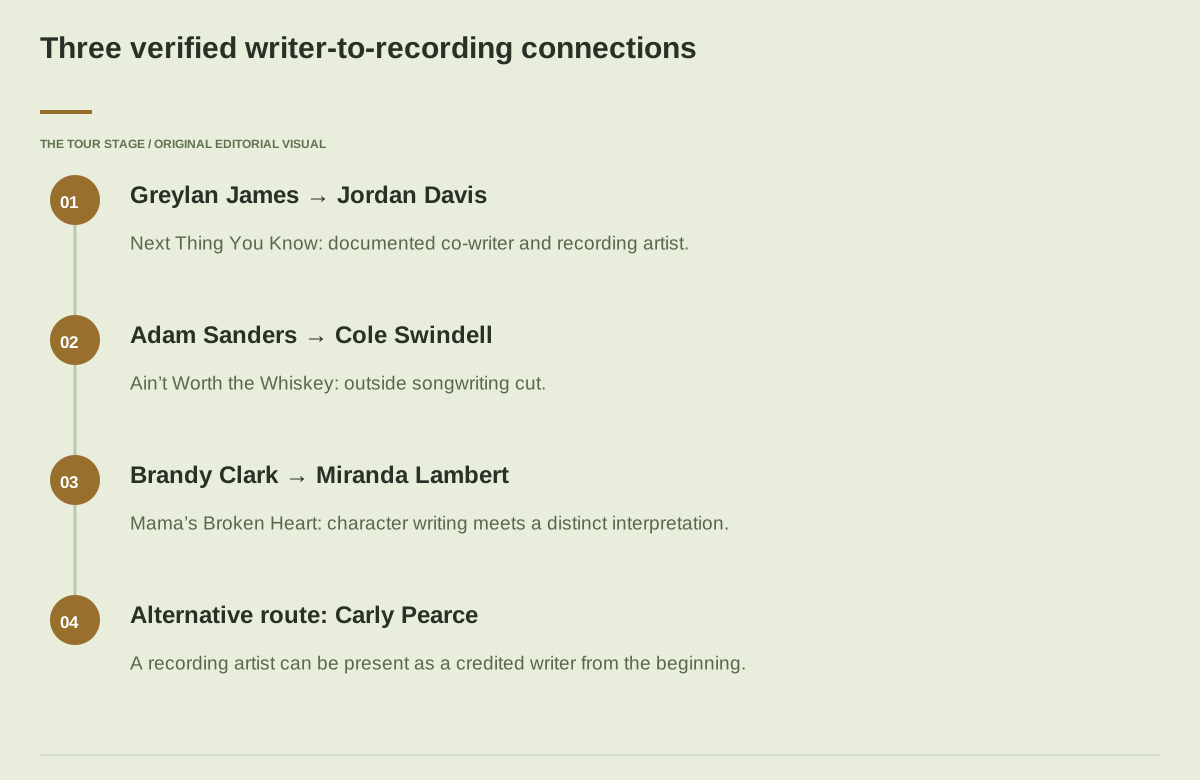
Three verified writer-to-recording connections
- Greylan James → Jordan DavisNext Thing You Know: documented co-writer and recording artist.
- Adam Sanders → Cole SwindellAin’t Worth the Whiskey: outside songwriting cut.
- Brandy Clark → Miranda LambertMama’s Broken Heart: character writing meets a distinct interpretation.
- Alternative route: Carly PearceA recording artist can be present as a credited writer from the beginning.
Read the visual as text
- Greylan James → Jordan DavisNext Thing You Know: documented co-writer and recording artist.
- Adam Sanders → Cole SwindellAin’t Worth the Whiskey: outside songwriting cut.
- Brandy Clark → Miranda LambertMama’s Broken Heart: character writing meets a distinct interpretation.
- Alternative route: Carly PearceA recording artist can be present as a credited writer from the beginning.
Why a song can suit someone other than its writer
A writer may discover that a song’s emotional stance fits another voice more readily than their own current project. That does not mean the writer could never sing it, or that the eventual artist merely repeats a demo. Key, tempo, arrangement and vocal emphasis can change the relationship between the narrator and audience. A composition may carry a clear dramatic idea while leaving many performance choices open. When comparing a writer’s own material with an outside cut, hear how the recording artist handles the same kind of emotional turn rather than searching for a hidden original version. If no official demo is available, the released record is sufficient for analysis. Absence of a publicly documented intermediate stage is a reason to leave that stage open, not to manufacture it.
Adam Sanders to Cole Swindell: a collaboration within friendship
Adam Sanders’ publisher biography identifies his outside songwriting work, including Cole Swindell’s “Ain’t Worth the Whiskey.” His publicity materials likewise separate his writing credits from his recording career.23 Hear the track as a narrator redirecting the meaning of a familiar social ritual. The listener initially has one explanation for the scene, while the song’s central idea gives it another. That kind of turn is portable: it can be written collaboratively and then personalised through a singer’s delivery. Sanders’ later releases provide a useful comparison with his outside work, but the existence of both does not establish that every song was first planned for him. A career can include writing for others and developing a solo catalogue at the same time.
Brandy Clark to Miranda Lambert: character survives the handoff
Brandy Clark’ official biography lists “Mama’s Broken Heart,” recorded by Miranda Lambert, among her writing credits.4 The recording is useful for hearing how character writing and performance intensity reinforce one another. A narrator’s response is set against expectations of how she should behave; the singer can make that conflict vivid through attack, pacing and changes in force. Discuss those audible features without assuming that the event describes Clark’s or Lambert’s private life. A good character can travel between a writer and a singer because it contains a clear dramatic pressure. The singer’s task is to make that pressure feel immediate. The story-song guide offers another way to follow narrator, conflict and consequence.
A co-write with the artist already in the room
Carly Pearce’s “I Hope You’re Happy Now,” written with Luke Combs, Jonathan Singleton and Randy Montana, provides a different route. Curb’s release announcement documents the writers and the duet with Lee Brice; Pearce’s interview describes writing from a difficult past relationship.56 Here the eventual artist is already a credited writer, so a generic outside-pitch story would misdescribe the evidence. The duet later adds another performer without turning that performer into one of the listed authors. This is why a song-journey diagram should allow different starting arrangements. Sometimes artist and writers develop the material together; sometimes a singer finds a song already composed. Neither model automatically produces a better recording. The important question is how the specific song found an effective musical home.
What demos, publishers and pitches actually explain
A demo communicates a song well enough for another listener to imagine a finished record. It need not be an elaborate master, and its singer need not be the eventual artist. A publisher can help administer and promote compositions, while a producer or artist team may help choose songs for a project. These are descriptions of functions, not claims that a particular company handled every stage of the examples above. Public interviews can reveal one portion of a route, but a tidy article should not silently supply the rest. Similarly, a songwriting credit does not reveal an individual’s financial terms, ownership share or payment history. Those are contractual questions with facts of their own. List the verified writer-to-recording connection and resist turning a common industry practice into a specific undocumented event.
Listen to the handoff, then widen the network
Build a three-song session from “Next Thing You Know,” “Ain’t Worth the Whiskey” and “Mama’s Broken Heart.” For each, identify the mechanism that makes the idea memorable: compressed time, a reversal of meaning or a character under pressure. Then listen to one recording by James, Sanders or Clark as an artist. Compare how each voice handles a line, rather than treating the outside cut as a more important version of the writer’s work. Use the artists behind other artists’ songs guide and collaboration atlas to continue through verified credits. The next discovery may be an unfamiliar writer whose work already lives in your favourite singer’s catalogue. That connection is enough to begin; the full history can remain more complicated than a straight arrow.
Sources & further reading
- Greylan James official biographyNext Thing You Know co-writing connection.
- Liz Rose Music: Adam SandersPublisher account of songwriter and outside cuts.
- Adkins Entertainment: Sanders publishing announcementWriter career and documented publishing announcement.
- Brandy Clark official biographyMama’s Broken Heart outside writing credit.
- Curb official Pearce/Brice releaseWriters and separate duet roles.
- Carly Pearce first-person songwriting interviewPearce’s account of writing I Hope You’re Happy Now.