A technique name rather than a genre
A flatpick is a plectrum held between fingers to strike the strings. Flatpicking commonly describes acoustic lead playing in country and bluegrass, although picks also play rhythm guitar and appear across many genres. The technique does not automatically imply a particular speed, guitar brand or level of difficulty. It describes a physical starting point from which musicians make very different choices.
For a listener, the useful question is how each note relates to the pulse. A picked melody may move evenly, lean into accents or leave a surprising gap. A guitarist can make a simple tune feel urgent without adding many notes. Conversely, a dense passage can feel relaxed when its accents settle clearly into the band. Begin with that audible relationship and leave technical labels until they help explain something specific.
Downstrokes, upstrokes and the route through strings
A downstroke moves the pick towards the floor in the usual playing position; an upstroke reverses that direction. Alternating them is one way of organising repeated notes. Crossing strings introduces another task: the player must arrive at the next string in time while keeping the phrase connected. Some passages use other stroke combinations to serve their particular musical shape.
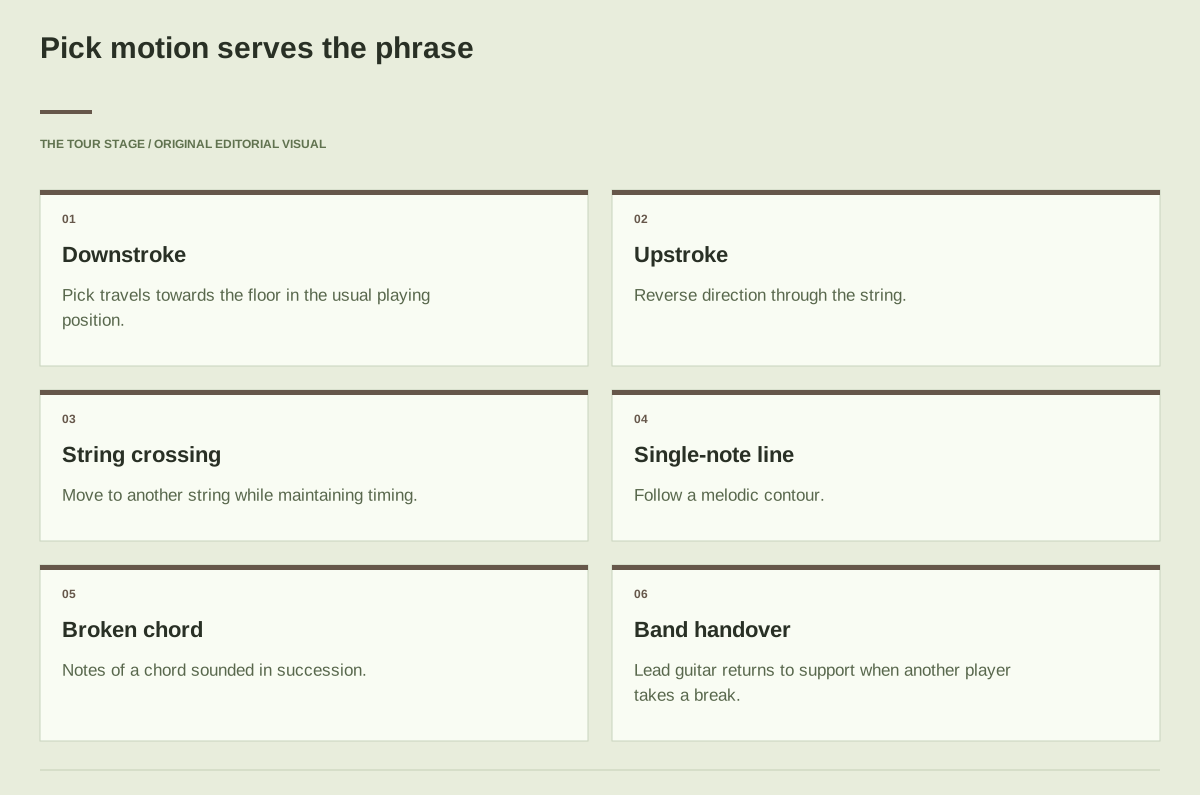
Our pick-motion diagram is intentionally generic. It demonstrates two directions and a change of string; it is not tablature for a commercial recording. Avoid hearing every even passage as proof of one precise right-hand pattern. An audio recording rarely reveals the whole motion, and a camera angle can conceal it. Use an official player demonstration when studying technique, then return to the record to hear why the choice matters. The purpose of motion is a musical phrase, not a visible exercise.
Pick motion serves the phrase
- DownstrokePick travels towards the floor in the usual playing position.
- UpstrokeReverse direction through the string.
- String crossingMove to another string while maintaining timing.
- Single-note lineFollow a melodic contour.
- Broken chordNotes of a chord sounded in succession.
- Band handoverLead guitar returns to support when another player takes a break.
Read the visual as text
- DownstrokePick travels towards the floor in the usual playing position.
- UpstrokeReverse direction through the string.
- String crossingMove to another string while maintaining timing.
- Single-note lineFollow a melodic contour.
- Broken chordNotes of a chord sounded in succession.
- Band handoverLead guitar returns to support when another player takes a break.
Molly Tuttle: clarity inside a complete song
Nonesuch’s official page for Crooked Tree supplies a documented starting point for Molly Tuttle and Golden Highway, including the recording’s band context.1 Choose the title track and focus first on the guitar’s attack and the spaces around it. The flatpicked line should be heard in relation to the singing and the other instruments, not isolated as a sports statistic.
Then compare a passage from City of Gold, whose label page provides another verified listening route.2 Our editorial question is whether the line feels like an extension of the song’s melody, a rhythmic answer or a new development. Tuttle’s records are useful because a listener can enjoy a complete song while still noticing the guitar’s precision. Do not turn a written album credit into a claim that a particular solo uses a particular fingering; that requires a demonstration or first-person explanation.
Billy Strings: hearing a phrase develop
Billy Strings’ official Live Vol. 1 page identifies an authorised live release, a better source for studying his concert playing than an unattributed clip with uncertain audio.3 Use “Dust in a Baggie” as one entry point, checking the version in the release listing. Follow a short melodic idea through its repetitions and changes.
Listen underneath that line. Does the accompaniment maintain a stable pulse, become quieter or open space for a longer phrase? An extended instrumental passage depends on those relationships. The most revealing moment may be the return to a recognisable tune after exploration, because it shows how much shared structure remained in place. A long performance is not automatically a demonstration of more skill than a short one. Judge the musical conversation: whether the players keep direction, respond and make the arrival feel earned.
Rhythm guitar is part of the picture
A bluegrass guitar part often alternates bass notes with chordal rhythm, but real performances vary the pattern. A lead break changes the guitarist’s responsibility without erasing the need for pulse. When the guitar steps forward, bass and other chord instruments help preserve the framework. When it steps back, the guitar can make another instrument’s line easier to hear.
The Del McCoury Band is a useful ensemble to explore for that relationship. Do not label every guitar sound on a band release as the same person without checking its credits. Listen for the difference between a chord supporting a singer and a single-note response after the line. The mandolin guide explains another source of rhythmic punctuation; the banjo guide explains why a continuous picked texture can support rather than replace the guitar’s contribution.
What crosspicking sounds like to a listener
Crosspicking commonly describes patterned picking across several strings that creates a rolling texture. The listener may hear notes overlap or a repeating contour travel through a chord. It is different from merely playing a very fast scale on one string, but the distinction is about organisation rather than superiority. Several right-hand approaches can produce a crosspicked effect.
Try describing a passage without using the term first. Does it sound like a single melody, a broken chord or several little lines passing one another? Then watch a player-led demonstration at a comfortable speed if you want to connect the effect to motion. Resist the temptation to publish a guessed transcription based on a short video. A clean original exercise can explain the concept, while the authorised performance preserves the musician’s actual phrasing. Listening knowledge and a usable guitar lesson overlap, but they require different kinds of evidence.
A repeatable way to compare performances
Choose one studio track and one authorised live performance. On the first pass, tap the underlying pulse and notice where the guitar lands against it. On the second, follow beginnings and endings of phrases rather than individual notes. On the third, hear the supporting musicians. Write a short description using concrete terms: clear attack, connected phrase, repeated figure, space before the return.
Keep volume comfortable and match playback levels before comparing tone; louder can seem brighter or more exciting even when the playing is unchanged. You do not need software measurements to notice that bias. Most importantly, do not make speed the final score. Flatpicking becomes expressive through emphasis, timing and choices about what to leave out. For a wider setting, use the bluegrass ensemble comparison and hear how a guitarist’s technique becomes one part of a band’s shared sound.
Sources & further reading
- Nonesuch: Crooked TreeMolly Tuttle & Golden Highway recording and credited musicians.
- Nonesuch: City of GoldOfficial album account, personnel and recordings.
- Billy Strings: Live Vol. 1Official live album and documented recording titles.