Begin before the bluegrass stereotype
The banjo is often pictured as an uncomplicated emblem of rural white Appalachia. That image leaves out the people and cultural encounters central to its history. Smithsonian materials identify African antecedents and the instrument’s place in African American musical traditions.1 An honest introduction begins there, rather than adding Black history as a footnote after a story about commercial country music.
It is also misleading to imagine one unchanged African instrument transported intact into every later American setting. Construction, repertory and performance practices developed through exchange under radically unequal conditions, including slavery. The resulting history is complicated and should remain visible. For a listener, that means keeping two ideas together: the banjo has a deep Black history, and musicians from many communities have developed distinct traditions around it. Neither point cancels the other.
What a banjo’s construction lets you hear
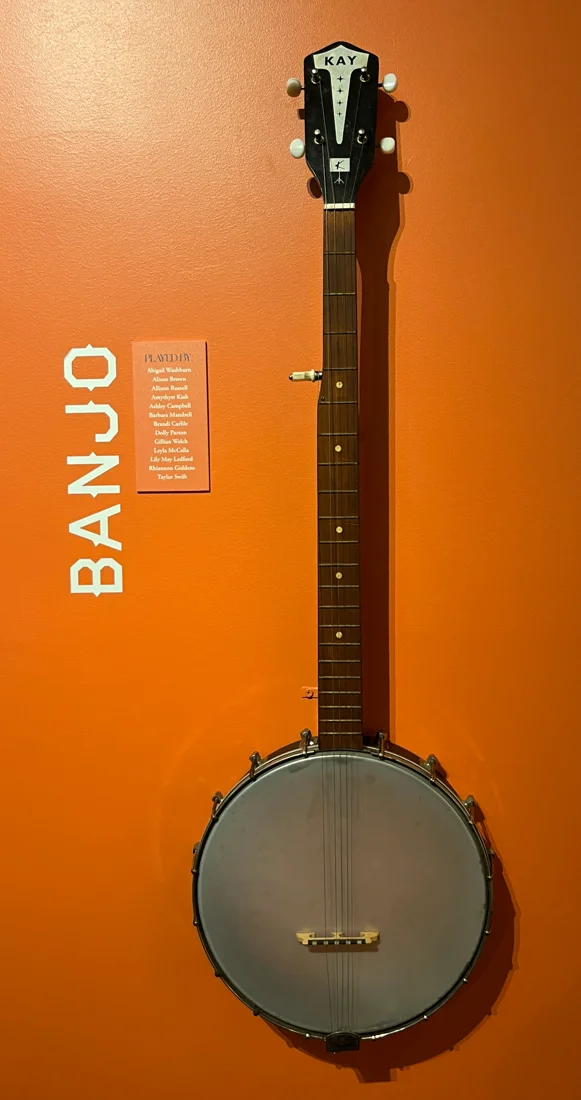
The banjo’s strings run across a bridge resting on a stretched membrane, usually called the head. That vibrating surface helps create its distinctive attack. A common bluegrass banjo has five strings, including a shorter fifth string; other banjos have different string counts and musical purposes. Open-back and resonator instruments are useful distinctions, but neither construction creates an absolute rule about who may play which style.
Listen to the beginning and end of a note. Compared with a bowed fiddle line, a banjo note often has a conspicuous, bright onset. The player turns many such events into a rhythmic stream. Notes can overlap, be damped or be given contrasting emphasis. The instrument is therefore more than a metallic texture added to make a track sound country. Its repeating patterns can organise the whole band’s sense of forward motion even when the melody sits elsewhere.
Banjo history and listening: context before categories
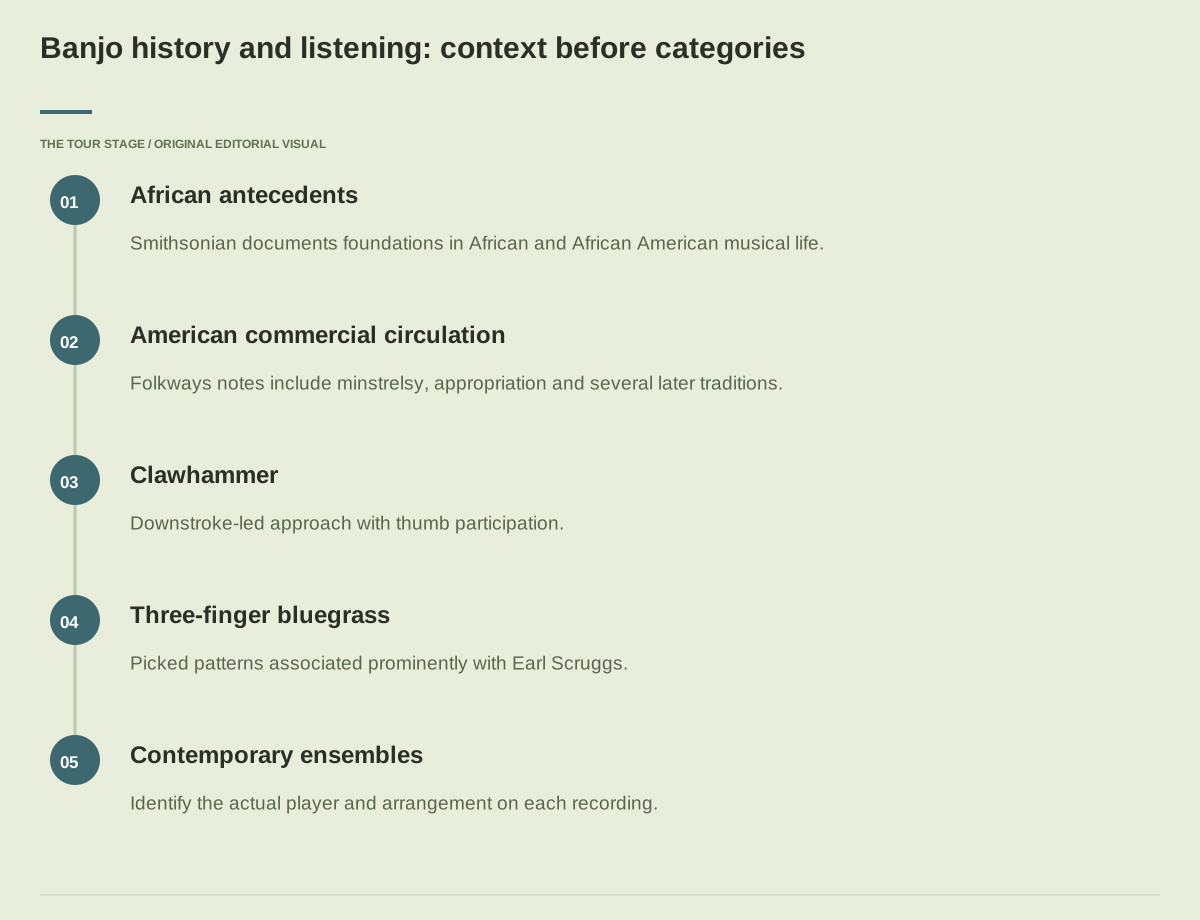
- African antecedentsSmithsonian documents foundations in African and African American musical life.
- American commercial circulationFolkways notes include minstrelsy, appropriation and several later traditions.
- ClawhammerDownstroke-led approach with thumb participation.
- Three-finger bluegrassPicked patterns associated prominently with Earl Scruggs.
- Contemporary ensemblesIdentify the actual player and arrangement on each recording.
Read the visual as text
- African antecedentsSmithsonian documents foundations in African and African American musical life.
- American commercial circulationFolkways notes include minstrelsy, appropriation and several later traditions.
- ClawhammerDownstroke-led approach with thumb participation.
- Three-finger bluegrassPicked patterns associated prominently with Earl Scruggs.
- Contemporary ensemblesIdentify the actual player and arrangement on each recording.
Minstrelsy belongs in the account
Smithsonian Folkways’ Classic Banjo liner notes place the instrument in settings including blackface minstrelsy, old-time music, jazz, country and bluegrass. They also discuss appropriation and the violence surrounding its early American history.2 That evidence prevents a cheerful timeline from presenting every change as neutral progress. Commercial circulation could spread the instrument while also distorting whose music audiences thought they were hearing.
A responsible listening route does not need to reproduce offensive stage material to explain that process. It can name the context, identify its consequences and move towards recordings that make the breadth of banjo practice audible. Museum objects, liner notes and named performers are more useful than a sweeping claim about an entire region. Avoid a timeline in which the instrument disappears from Black musical life the moment it becomes visible in commercial white entertainment; that would repeat the erasure the history needs to address.
Clawhammer and three-finger picking are approaches
In a common clawhammer approach, a finger strikes down towards the strings while the thumb participates in the rhythmic pattern. In three-finger bluegrass playing, thumb and fingers pick combinations of strings to produce repeating and varied patterns often called rolls. Those descriptions are entry points, not complete instructions or a binary map of all banjo music. There are other fingerpicking traditions, techniques and personal combinations.
For listening, compare the organisation of sound. A clawhammer passage may make a repeating rhythmic gesture particularly easy to follow. A three-finger passage may distribute accents within a continuous stream of picked notes. Either can carry melody, support singing or change its emphasis. Do not equate clawhammer automatically with simple playing or three-finger technique with speed. Musical complexity depends on what the player does with time, melody and interaction, not merely how many fingers a description names.
Earl Scruggs in a specific band
Earl Scruggs offers a documented way into bluegrass banjo without being made responsible for every banjo tradition. The Bluegrass Music Hall of Fame traces his work with Bill Monroe and the Blue Grass Boys and his subsequent career.3 Listen to his playing as part of an ensemble: the banjo’s drive takes meaning from the guitar, bass, mandolin, fiddle and voices around it.
“Foggy Mountain Breakdown” is a useful recognised title to explore in an official Flatt and Scruggs release. First follow the recurring instrumental idea; then listen for the support under the lead. The flatpicking guide and mandolin guide explain two neighbouring roles. A bluegrass break is not just a chance to play over everyone else. It is a coordinated change in the foreground that requires the other musicians to hear and respond.
Country records use banjo in different ways
A banjo can be a principal melodic voice, a repeating rhythmic figure or an occasional production colour. A bright picked sound in a country-pop track does not prove the whole arrangement follows bluegrass practice. Listen for the surrounding instruments and the way solos are organised before applying a style label. Likewise, a band with acoustic instruments may make music that reaches beyond conventional bluegrass.
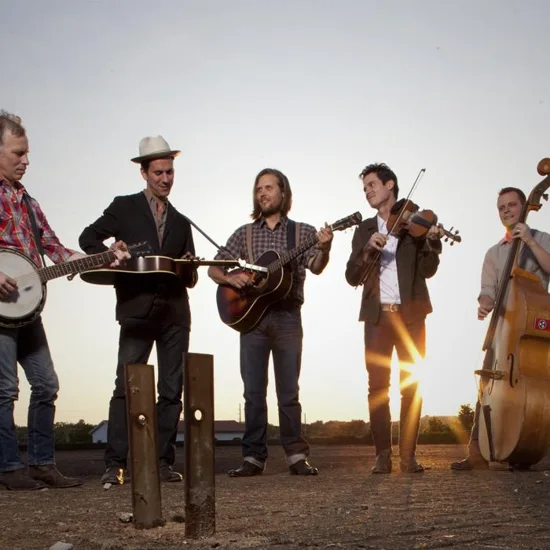
Explore Old Crow Medicine Show beside Billy Strings and Molly Tuttle, using the credits for each particular recording. Their inclusion is a route into different ensemble worlds, not a claim that all three lead artists play banjo on every release. Ask who actually holds the instrument, whether the part supports dancing or singing, and how it changes when another musician takes the foreground. Naming the player is a small but useful correction to instrument-as-stereotype listening.
A listening route with the history still attached
Begin with the Smithsonian collection’s range of traditions, then hear a documented Scruggs performance, and finish with a contemporary band recording. At each stop, make two notes: what the banjo does and what the source tells you about the performer. Keeping those notes separate prevents musical impressions becoming unsupported historical claims. A driving rhythm is something you can hear; a claim about where a technique originated requires evidence.
The goal is not to turn every listening session into an examination. It is to replace a narrow picture with a more accurate and rewarding one. Hear the instrument’s sharp attack, its rhythmic continuity, its capacity for melody and its quieter possibilities. Retain the African American foundations while recognising the creativity of later musicians. For the larger ensemble context, continue with bluegrass and country; for the broader visual reference, visit the instrument map.
Sources & further reading
- Smithsonian: Roots of African American MusicAfrican antecedents and the central place of Black musical traditions.
- Smithsonian Folkways: Classic Banjo liner notesAfrican American origins, historical appropriation and varied banjo traditions.
- Bluegrass Music Hall of Fame: Earl ScruggsScruggs career and three-finger bluegrass banjo.