Keep the attraction specific
Before opening another video, identify what made the first one work for you. Was it a rough vocal entrance, a line delivered conversationally, a guitar sound or the release into a chorus? A precise description gives you something to follow through a catalogue. “I like this singer” is a useful feeling, but “I like how the voice stretches across a steady rhythm” is a better listening question. Do not mistake the visual situation for the arrangement: a bedroom performance, a crowd reaction and a carefully edited montage can direct attention in different ways. Note the song title and performer, then find an official artist or label page. That small step helps distinguish the original recording from reposts, sped-up versions and clips that use another performer’s audio.
Find the complete song before the complete biography
Play the whole recording once without skipping to the part you already know. The clip may have captured the peak, while the verse explains why that peak matters. Notice the introduction, the time before the vocal arrives and the way the second chorus differs from the first. You do not need specialist vocabulary: describe an added instrument, a quieter entrance or a voice that sounds closer. Then replay the original fragment inside its larger setting. It may become more convincing, or you may prefer the fragment alone. Either result tells you something specific. Keep biographical reading brief at this stage, because an artist’s story can become a substitute for hearing their decisions. The story-song guide offers another route into structure and narrative without relying on excerpts.
From a fragment to a listening judgment
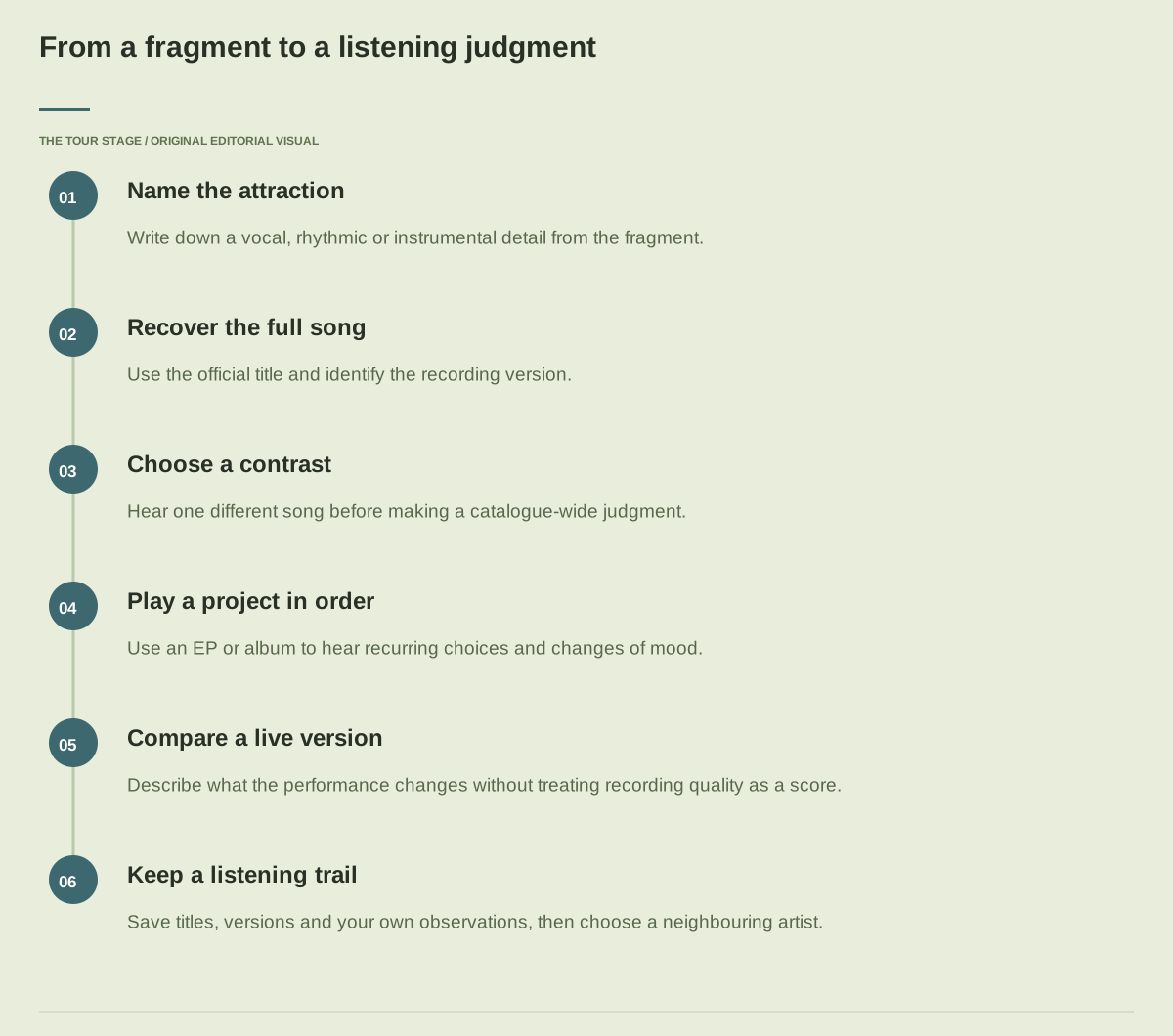
- Name the attractionWrite down a vocal, rhythmic or instrumental detail from the fragment.
- Recover the full songUse the official title and identify the recording version.
- Choose a contrastHear one different song before making a catalogue-wide judgment.
- Play a project in orderUse an EP or album to hear recurring choices and changes of mood.
- Compare a live versionDescribe what the performance changes without treating recording quality as a score.
- Keep a listening trailSave titles, versions and your own observations, then choose a neighbouring artist.
Read the visual as text
- Name the attractionWrite down a vocal, rhythmic or instrumental detail from the fragment.
- Recover the full songUse the official title and identify the recording version.
- Choose a contrastHear one different song before making a catalogue-wide judgment.
- Play a project in orderUse an EP or album to hear recurring choices and changes of mood.
- Compare a live versionDescribe what the performance changes without treating recording quality as a score.
- Keep a listening trailSave titles, versions and your own observations, then choose a neighbouring artist.
Blake Whiten: move from a single to a project
Warner’s official biography identifies Blake Whiten’s early singles “Breakin’ My Heart” and “Rollin’ Stone.” His publicity materials also identify the 2025 EP Six Mile.12 These provide two different ways into the catalogue: a complete song that can be compared with a short performance, and a compact project that asks for a longer stretch of attention. Listen to the first two tracks of the EP in order before choosing favourites. Keep the question small: does the vocal phrasing stay consistent when the arrangement changes? Look for a second mood rather than another copy of the breakout moment. This is a method for discovering range, not a claim that an early project must contain every direction an artist will take. Release context matters more than an unsupported description such as an overnight success.
Elizabeth Nichols: hear how a narrator works across songs
The official Elizabeth Nichols music page lists the Tough Love EP alongside singles including “I Got A New One,” “Trailer Treasure” and “Somebody Cooked Here.”3 Begin with the song that first caught your attention, then choose one differently titled release from that official list. Listen for who appears to be speaking and whom the singer addresses. A forceful hook can be a dramatic position within one song rather than a complete summary of the performer. In a second pass, attend to how conversational details fit the rhythm. Do the words feel pushed forward, held back or laid evenly across it? These are listening prompts rather than assertions that every Nichols recording shares a single personality. The songwriters and interpreters feature helps separate the performer, the written narrator and the people credited with creating the song.
Tyler Nance: label the version you are hearing
The official Tyler Nance site presents “Keeps Me Sane” with the Castellows as a named collaboration and also provides an official “Shovel” video.4 A title alone is therefore not enough to identify the version in your notes. Write down whether you played a solo release, a collaboration, a studio video or a live performance. A shared vocal can change the emotional perspective and the distribution of musical attention without turning the recording into an entirely different song. Compare the opening, the first chorus and one later passage, then listen straight through. Avoid inferring an entire catalogue from an algorithmically supplied follow-up: choose deliberately from the artist’s own release page. When an album, single and featured version coexist, record which one you actually liked so that a future listening session begins from the right place.
Bayker Blankenship: give a short EP time to establish itself
Bayker Blankenship’s official biography identifies “Maxed Out” and the Younger Years EP, released in July 2024.5 The EP is a manageable next step for someone who has heard only a clip. Play it in its published order and give each track a brief note about pace, vocal stance or arrangement. You are looking for connections and differences, not proving that every song deserves the same reaction. A quieter or less immediately catchy track may explain the emotional setting of the more familiar one. If it does not appeal, describe why without treating your response as a measurement of quality. Once you have heard the sequence, return to “Maxed Out” and ask whether its role has changed: does it now sound representative, unusually direct or simply like the clearest first invitation? That is a more useful judgment than repeating a streaming total.
Use a live comparison to ask a different question
After the studio release, choose one official full live performance if the artist supplies it. Compare what musicians do, how the vocal sits against the rhythm and where space opens around the song. Do not use phone-recording sound quality as a direct measure of the band’s balance in the room. Equally, a polished performance film may have its own production decisions. Neither version needs to replace the other. Write one difference that changes the experience: a longer instrumental passage, a shared chorus, a restrained verse or a different tempo feel. The live-album guide explores what performance records can reveal, while an artist finder can suggest a neighbouring sound once you know what you want to hear next. A useful comparison expands the question rather than declaring a winner.
Finish with a small, repeatable listening route
Keep a five-item trail: the original clip, its complete song, a second contrasting song, the EP or album that contains it, and one live comparison. Add release titles and version labels beside your own observations. This is enough structure to make discovery intentional without turning leisure into homework. Share a complete track with a friend and explain one specific reason for the choice. If the longer project does not hold your attention, stop there and return later; curiosity does not create an obligation to become a fan. If it does, choose a neighbouring artist through an audible connection rather than an unexplained recommendation. Over time the route becomes a record of what you heard, while the clip remains what it was at the start: a useful doorway into music that can be experienced on a much larger scale.
Sources & further reading
- Warner Records: Blake Whiten biographyEarly single titles and artist context.
- Blake Whiten official publicity: debut record contextIdentifies the Six Mile EP and official artist site.
- Elizabeth Nichols official music catalogueNamed EP and single releases.
- Tyler Nance official siteOfficial videos and named featured version.
- Bayker Blankenship official biographyMaxed Out and July2024 Younger Years EP.