
Begin with a song whose authors are documented
MCA’s official release for “Next Thing You Know” names Jordan Davis, Chase McGill, Josh Osborne and Greylan James as writers.1 That is the first important distinction: the voice delivering the finished record is not the complete songwriting credit. Davis is both recording artist and co-writer here, while James’s authorship is a different contribution from a featured vocal.
A songwriting room can generate a title, melodic phrase, narrative idea or a more complete draft. Those possibilities are a general explanation, not a reconstruction of private conversation in this particular room. The public release establishes the credited result; it does not tell us the exact minute each person proposed a line. Good process reporting preserves that boundary. A useful story can explain roles without filling undocumented gaps with an imaginary scene.
The dramatic idea survives changes of arrangement
The song’s narrative moves through stages of a life, making sequence and compression central to its effect. Our editorial reading is that each development needs to feel connected to what preceded it, even as time moves quickly. The record’s musical choices support that continuity: the listener follows a life rather than a collection of disconnected incidents.
This is a place where song and recording should be separated. You could imagine the narrative sung over one acoustic instrument and still recognise the composition. A full arrangement changes the pace, scale and emotional emphasis of that experience. It can help a transition arrive naturally or make a repeated phrase feel newly significant. The story-song guide examines those narrative tools without reproducing lyrics. Thinking in terms of character, movement and perspective is more revealing than treating the production as decoration added after the real creative work is finished.
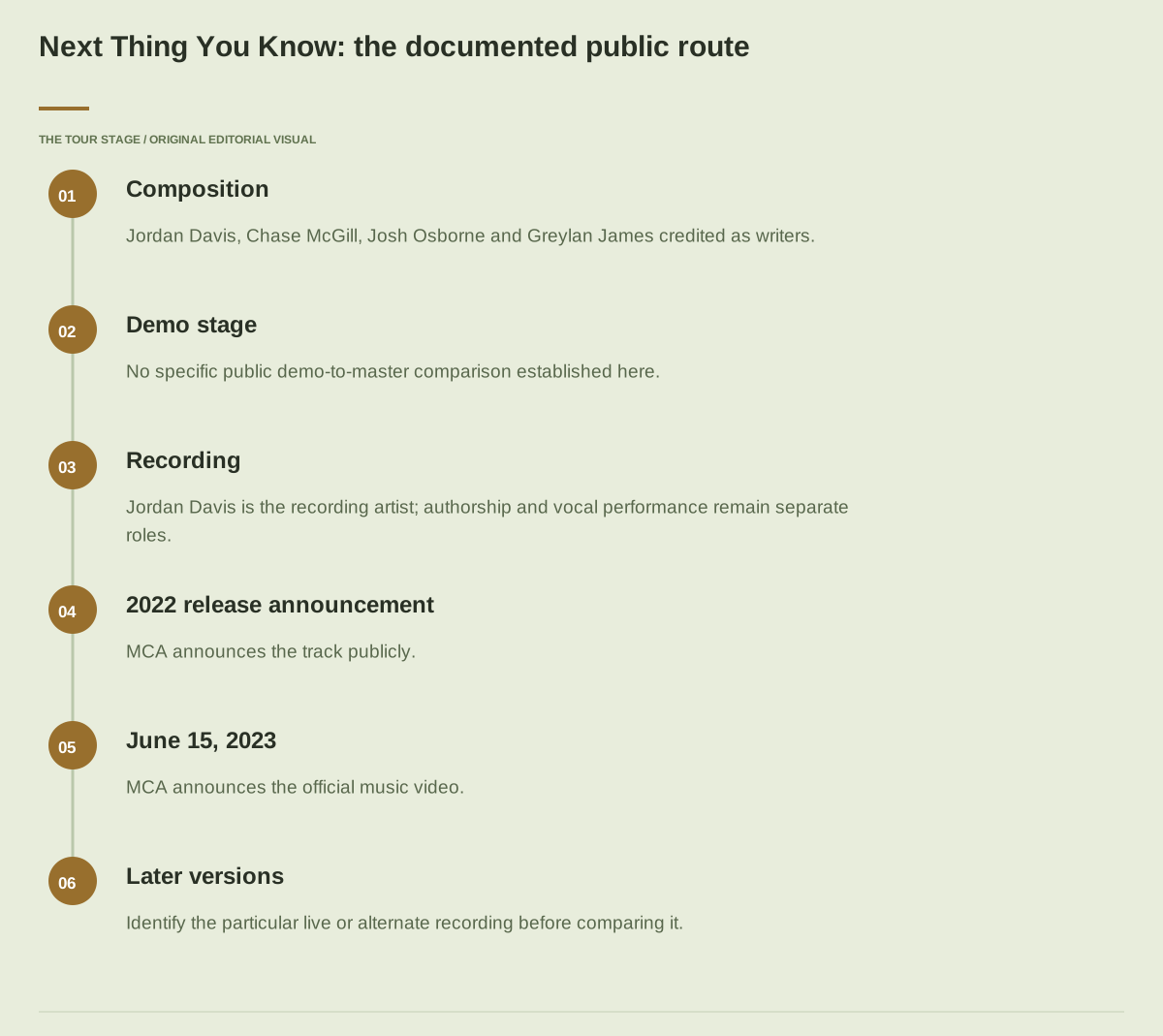
Next Thing You Know: the documented public route
- CompositionJordan Davis, Chase McGill, Josh Osborne and Greylan James credited as writers.
- Demo stageNo specific public demo-to-master comparison established here.
- RecordingJordan Davis is the recording artist; authorship and vocal performance remain separate roles.
- 2022 release announcementMCA announces the track publicly.
- June 15, 2023MCA announces the official music video.
- Later versionsIdentify the particular live or alternate recording before comparing it.
Read the visual as text
- CompositionJordan Davis, Chase McGill, Josh Osborne and Greylan James credited as writers.
- Demo stageNo specific public demo-to-master comparison established here.
- RecordingJordan Davis is the recording artist; authorship and vocal performance remain separate roles.
- 2022 release announcementMCA announces the track publicly.
- June 15, 2023MCA announces the official music video.
- Later versionsIdentify the particular live or alternate recording before comparing it.
What a demo can and cannot tell you
A demo presents a song so that an artist, producer or publisher can hear its possibilities. It might be a spare voice-and-guitar recording or a developed arrangement. “Demo” describes its purpose in the process, not one guaranteed sound quality. Some demos influence later decisions closely; others primarily communicate melody, words and form.
No verified demo recording is required to enjoy “Next Thing You Know,” and the official sources here do not establish a public demo-to-master comparison. We therefore do not claim that a particular instrument, tempo or vocal phrase was changed between versions. Instead, the useful question is what a demo would need to communicate: the narrative trajectory, the melodic identity and a convincing sense of emotional direction. If a writer later shares an authorised demonstration, compare that actual version. An unattributed clip with a filename saying “original demo” is not enough evidence to reconstruct the song’s route.
Recording makes the artist’s perspective concrete
Once a song is selected for recording, the performance must establish a particular voice and point of view. Key, tempo, phrasing and instrumental space affect whether the singer sounds conversational, forceful or reflective. Musicians and producer can test those choices in the room. Different sessions organise the work differently, so this is a description of tasks rather than a universal production schedule.
The lead vocal is especially consequential in a narrative song. A small pause can make an event feel surprising; a phrase carried across the bar can make time seem to rush forward. Our listening exercise is to follow those changes without assuming they were spontaneous or assembled from any particular number of takes. The finished record supports an interpretation of the effect. Session documentation or a first-person account would be needed to establish how that effect was created.
Release adds a public identity to the recording
The original label announcement for “Next Thing You Know” appeared in 2022; MCA’s subsequent official video announcement is dated June 15, 2023.2 Those are different public steps in the life of the same song. A track’s availability, radio campaign, video and later award attention should not be compressed into one invented release moment.
A video gives the recording another interpretive setting, but it is not the origin of the underlying composition. Likewise, a later live performance can alter arrangement and emphasis without becoming the original studio master. When comparing versions, write down the exact release and format. That small habit resolves many apparent contradictions in dates and personnel. It also protects a songwriter’s role from disappearing when a record becomes strongly associated with the singer’s public life.
Other writers reveal other possible routes
Adam Sanders provides a contrasting example. His publisher Round Hill confirms cuts including Cole Swindell’s “Ain’t Worth the Whiskey” and Dustin Lynch’s “Hell of a Night.”3 Those credits show a songwriter’s work reaching listeners through other performers. They do not mean Sanders is a featured singer on either master.
Brandy Clark offers another useful listening route as both an artist and writer. Compare an artist’s own recording with a documented outside cut only when the credits establish the connection. The songwriter-and-interpreter comparison explores why these models can coexist. Neither self-writing nor outside-song selection guarantees a more truthful performance. The practical question is how composition and interpretation fit together on the actual record, with credit given to each contribution.
Read the finished record as a chain of choices
Start with three facts: the credited writers, the identified recording and its public release context. Then add listening observations about narrative pace, vocal perspective and instrumental support. Keep an observation such as “the chorus feels broader” separate from an unsupported process claim such as “the producer added this instrument on the final day.” That distinction makes criticism more precise rather than less interesting.
Our workflow graphic therefore includes a marked unknown at the demo stage of this case. It is an honest gap in the public evidence, not a problem to hide. The route remains useful: shared writing creates a composition, a recording gives it one performed form and release places that version before listeners. For more detail, continue with the producer’s role and reading credits. They explain how a single familiar song can involve several creative roles without those roles becoming interchangeable.
Sources & further reading
- MCA: Next Thing You Know releaseSongwriters Jordan Davis, Chase McGill, Josh Osborne and Greylan James.
- MCA: Next Thing You Know videoDated 2023 official video release and authorship.
- Round Hill: Adam SandersPublisher confirmation of Sanders cuts for Cole Swindell and Dustin Lynch.