Ask independent in which respect
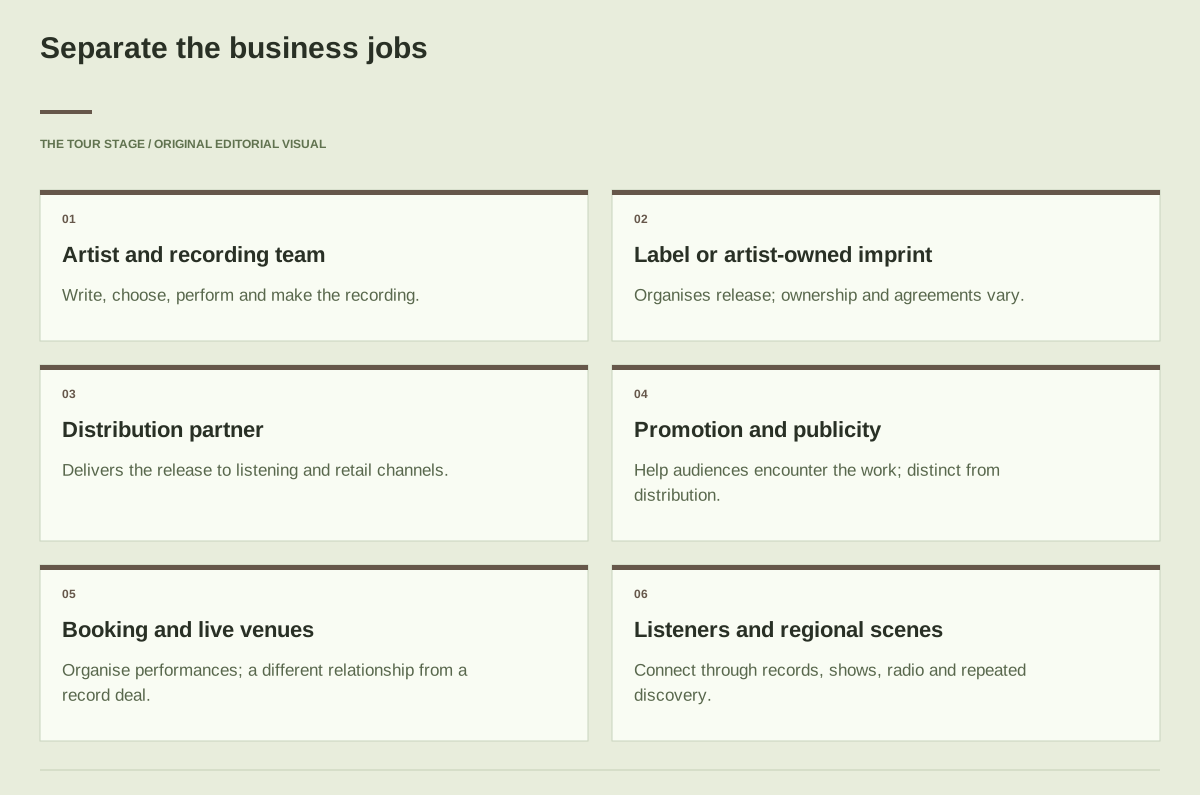
An artist may own a label, license a recording to another company, use an outside distributor and hire radio promotion or management. Those arrangements concern different jobs. “Independent” can describe ownership, an organisational structure or a way an artist talks about creative control; it does not automatically mean doing every task alone. Nor does a major-label partnership identify who wrote the songs or played the instruments. Start with a dated release and read the artist, label and distribution wording separately. This guide uses documented examples rather than a universal contract model. The diagram shows functions that can connect in different ways, not a claim that every artist employs the same companies or enjoys the same terms. No revenue percentage can be inferred from the label name alone.
Aaron Watson: an artist-owned label with partners
Aaron Watson’s official Red Bandana announcement identifies the 2019 album as a BIG Label Records release distributed by ADA Worldwide. In the museum’s Voices in the Hall interview, Watson describes investing personally in his recordings and running his own label.12 This is a concrete example of ownership and external support coexisting. A distributor is part of how the work reaches listeners; using one does not mean the artist has ceased to operate a label. The album also gives a listener a better subject than a slogan. Hear the relationship between a long sequence, the writing voice and the country arrangements. Business independence may create possibilities, but the recorded result still has to work as music. Evaluate those choices directly rather than assuming a particular corporate structure guarantees artistic quality.
Separate the business jobs
- Artist and recording teamWrite, choose, perform and make the recording.
- Label or artist-owned imprintOrganises release; ownership and agreements vary.
- Distribution partnerDelivers the release to listening and retail channels.
- Promotion and publicityHelp audiences encounter the work; distinct from distribution.
- Booking and live venuesOrganise performances; a different relationship from a record deal.
- Listeners and regional scenesConnect through records, shows, radio and repeated discovery.
Read the visual as text
- Artist and recording teamWrite, choose, perform and make the recording.
- Label or artist-owned imprintOrganises release; ownership and agreements vary.
- Distribution partnerDelivers the release to listening and retail channels.
- Promotion and publicityHelp audiences encounter the work; distinct from distribution.
- Booking and live venuesOrganise performances; a different relationship from a record deal.
- Listeners and regional scenesConnect through records, shows, radio and repeated discovery.
Cody Jinks: a named label is useful evidence
Cody Jinks’ management’s release materials identify In My Blood as issued through his Late August Records.3 That dated, named relationship is more precise than calling the singer permanently unsigned. An artist operating a record label plainly participates in an organised release business, even when it differs from a major-label arrangement. Hear a record such as Adobe Sessions for a musical entry point, then follow the official catalogue forward. Do not treat a later label description as proof of the terms governing every earlier album. A catalogue can be reorganised, licensed or reissued under different arrangements. The reliable method is to attach each business claim to its documented moment. The singer’s familiar voice supplies continuity across the music, while the release credits supply evidence about the particular product.
American Aquarium: the artist’s imprint and release infrastructure
American Aquarium’s official biography identifies BJ Barham’s Losing Side Records as the home for New Ways to Lose, while the label’s own Wolves listing documents another part of its catalogue.45 That imprint is one layer of a working system, not an assertion that Barham performs every business function himself. The official catalogue and credits can identify the record; public interviews can explain more of the process when available. Hear how the band’s amplified setting gives a songwriter’s account a collective physical force. A business explainer should preserve that distinction between the artist’s writing identity and the contributions of bandmates. “Independent singer-songwriter” is not a reason to make the other musicians disappear. The band guide provides a practical way to keep those roles clear.
Flatland Cavalry: affiliations can change
Flatland Cavalry offers an important counterweight to treating independence as a permanent badge. The band’s official publicity identifies Wandering Star as its first release in partnership with Interscope in 2023; the label’s store documents later catalogue releases.67 A regional following and a later label partnership are not mutually exclusive histories. Neither should be erased to make a simpler narrative. If you begin with Humble Folks, listen to the writing, acoustic pulse and interplay of instruments before moving to a later record. You can describe changes in production without presuming that a company ordered every difference. A deal announcement establishes a relationship; it rarely supplies every creative decision. Use the Texas country ecosystem guide to understand how regional venues and audiences can remain relevant across business changes.
Distribution is a route, not a musical genre
A distributor helps deliver recordings to retail and listening services and may provide further support under a specific agreement. Marketing, publicity, radio promotion, booking and management have related but distinct functions. An artist-owned label can contract with outside organisations for some of them. Conversely, a familiar service-company name beside a release does not tell you the exact ownership or duration of an agreement. Keep the wording of the official announcement. “Released by,” “distributed by,” “marketed by” and “under licence to” describe different relationships; substituting one for another creates false certainty. The musical style is another question again. Country-rock, honky-tonk or a quiet acoustic ballad can emerge from several different business structures. The listening map therefore classifies sounds rather than using a label affiliation as a genre tag.
Regional audiences are networks of repeated contact
A regional scene can connect clubs, festivals, local radio, record shops and listeners who return to shows. That is a useful way to explain audience-building without inventing numbers or claiming that every career follows one ladder. Repeated performances give an artist chances to test songs, learn the pace of a room and develop relationships. They do not guarantee a national breakthrough or an evenly growing income. Avoid using sold-out language unless the specific show is documented, and do not turn a busy calendar into a profit calculation. As a fan, the practical route is straightforward: explore the official catalogue, check a legitimate local event listing and recognise the other artists on a shared bill. A scene is sustained by many overlapping careers, not one representative success story.
Compare records without romanticising the business model
For a compact listening session, take one Watson album, one Jinks album, one American Aquarium release and a Flatland Cavalry record from the documented label era. Write the exact label wording beside each, then make a separate note about the musical choices you hear. Keeping those columns apart prevents a circular argument in which a record sounds free only because you already know the artist calls it independent. The working songwriter guide shows another layer of professional collaboration. Support an artist through official music and show links if you choose, but do not assume an online purchase reveals how money is divided behind the scenes. The value of these examples is their variety: country careers can use several structures, and those structures can change while a recognisable artistic voice continues.
Sources & further reading
- Aaron Watson: Red Bandana announcement2019 BIG Label/ADA release relationship.
- Museum Voices in the Hall: Aaron WatsonFirst-person account of artist-owned label and investment.
- Red Light Management: Cody Jinks releaseLate August Records release.
- American Aquarium official biographyLosing Side Records and named release.
- Losing Side Records: WolvesArtist-owned imprint catalogue example.
- Sacks & Co: Flatland CavalryWandering Star first Interscope partnership.
- Interscope: Flatland ForeverLater label release evidence.