Draw a smaller, more honest map
This route connects Tyler Childers, Chris Stapleton and Kelsey Hart without pretending they represent every Kentucky tradition. Eastern Kentucky is part of Appalachia; the entire state is not interchangeable with that mountain region. A statewide music story also contains cities, migration, gospel, bluegrass, commercial country and musicians whose work crosses those descriptions. Use places to clarify a relationship rather than predict a sound. An artist’s birthplace does not settle their instrumentation, politics or working methods. The Kentucky Music Hall of Fame is a helpful institutional starting point for seeing how many careers coexist within the state’s musical history. A short editorial selection can be useful as long as its boundaries stay visible: these are three approaches to songwriting and singing, not the definitive Kentucky playlist.1
Tyler Childers: a narrator’s sense of place
Begin with Tyler Childers and Purgatory. Hear how a place can be established through an action, relationship or passing detail rather than a tourist description. The vocal sometimes pushes against the band’s pulse, making the narrator seem to be thinking aloud while the arrangement keeps moving. That tension helps explain why simply copying a regional accent would miss the music’s force. Then listen beyond the best-known opening tracks to the record’s changes of pace. A close lyric and a vigorous fiddle-led passage can belong to the same artistic world. Childers’ official catalogue is the authority for release titles and versions; distinguish the original recording from later live performances or a streaming compilation that rearranges the sequence.2
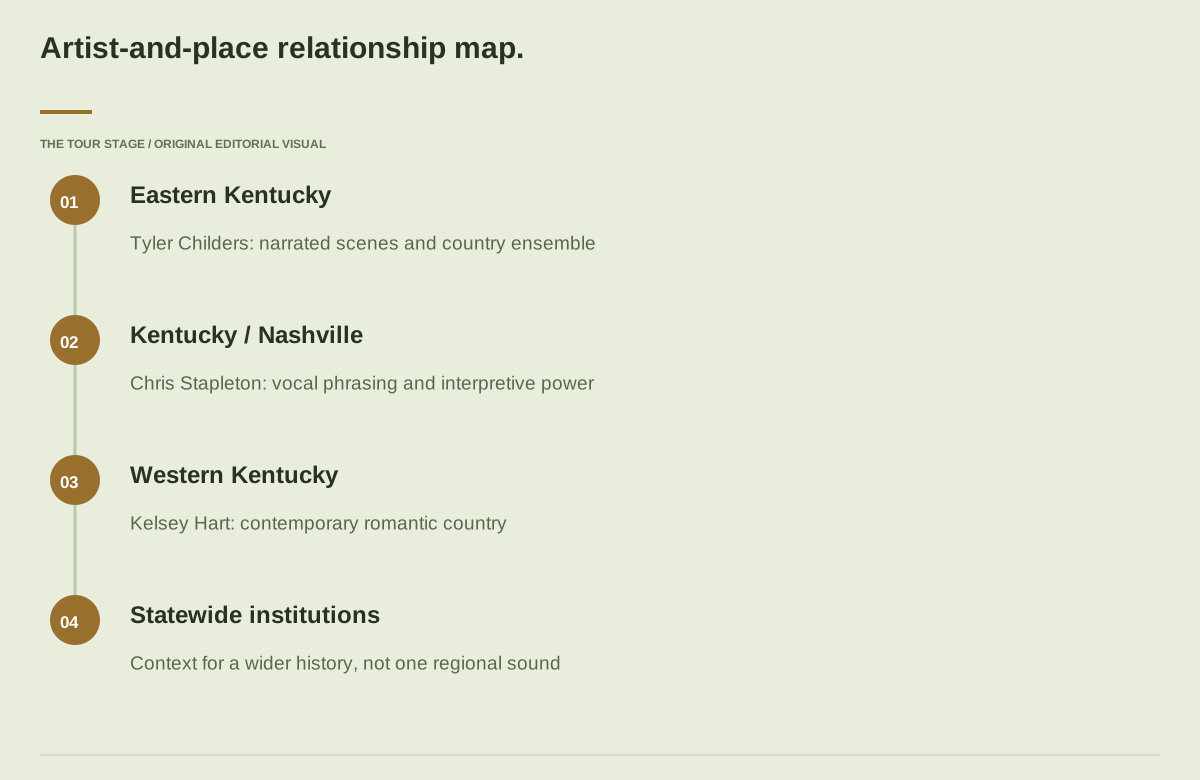
Artist-and-place relationship map.
- Eastern KentuckyTyler Childers: narrated scenes and country ensemble
- Kentucky / NashvilleChris Stapleton: vocal phrasing and interpretive power
- Western KentuckyKelsey Hart: contemporary romantic country
- Statewide institutionsContext for a wider history, not one regional sound
Read the visual as text
- Eastern KentuckyTyler Childers: narrated scenes and country ensemble
- Kentucky / NashvilleChris Stapleton: vocal phrasing and interpretive power
- Western KentuckyKelsey Hart: contemporary romantic country
- Statewide institutionsContext for a wider history, not one regional sound
Chris Stapleton: the voice as an arrangement
Use Chris Stapleton’s Traveller as a contrasting entry point. His official catalogue places it within a larger recording career, so it should not stand in for everything he has done. Listen to the space around the vocal: a held note can make a modest backing figure feel expansive, while a rough attack can move a line toward blues without abandoning a country song’s narrative. Compare the title track with his recording of “Tennessee Whiskey.” The latter is an interpretation of an existing song, a reminder that a singer’s artistry and a writer’s authorship are related but separate questions. Volume alone is not the explanation. Listen to where a phrase begins, how long a vowel lasts and whether the singer leans ahead of or behind the beat.3
Kelsey Hart: contemporary country from another Kentucky angle
Kelsey Hart adds a western Kentucky connection and a contemporary Nashville recording approach. Start with “Life With You” and the album carrying that title, using his official artist and label material to identify the release. The close romantic focus offers a different scale from the community narratives listeners may first associate with Appalachian songwriting. Hear how the production positions the vocal firmly in front and builds emotional emphasis through the chorus. This is not evidence that one part of Kentucky produces modern music and another preserves the past. It demonstrates why region is only one useful axis. A personal lyric can connect across geography, while a commercially polished arrangement can still depend on the grain and timing of an individual voice.4
Institutions supply context, not a compulsory itinerary
The Kentucky Music Hall of Fame and the state’s Country Music Highway material help connect careers to places and public memory. An institutional trail is an interpretive selection: it makes some stories visible, but it cannot establish that artists who share a road designation sound alike. If you travel, choose the museum or performance that supports your specific interest and verify opening arrangements through the operator. Do not turn a birthplace into an assumption that an artist will appear locally. Equally, do not treat a small community as a collection of song locations for visitors to enter. The Stillwater guide makes a similar distinction between documented gathering places and currently accessible music venues. Geography is most useful when it explains connections without claiming ownership of the music.
Three listening questions that avoid stereotypes
First ask how much information the narrator provides. A detailed scene and a broad emotional statement accomplish different things; neither automatically means more honest writing. Next ask what the rhythm does beneath the voice. A country shuffle, a slow soul-inflected groove and a straight contemporary pulse offer different possibilities for phrasing. Finally ask which instrument carries the answer to the singer. Fiddle, steel, electric guitar, backing vocals or a deliberate silence can each redirect the feeling of a line. Try those questions across Childers, Stapleton and Hart before reading a genre description. You will have audible evidence for your comparison instead of relying on a map colour, an accent or a promotional use of roots. These questions also work when you move beyond this introductory group.
Make room for the traditions this route does not cover
A three-artist route cannot explain Kentucky’s bluegrass history, Black musical traditions, sacred music, women’s songwriting or the full diversity of Appalachian communities. Treat those as further routes deserving their own sources and listening time. The point is not to add a token name to make a short list appear comprehensive. It is to recognise when a new question needs a new selection. If instrumental interplay draws you in, the small-band roots guide offers another way to listen. If powerful phrasing is the attraction, try the country-soul route, remembering that its label describes an editorial listening connection rather than a formal movement. One region can support many of these approaches simultaneously.
Build a six-track Kentucky session
Choose two complete songs per artist: one immediate entry point and one that changes your first impression. Keep their original release context visible rather than mixing studio and live versions without noticing. After each pair, write a sentence describing a musical choice: a restrained verse, a fiddle response, a delayed vocal entrance or a chorus built for broad participation. Avoid using authentic as a substitute for that sentence. Then return to the official biography and note exactly what the geographical connection is: upbringing, birthplace, a working community or an adopted base. Distinguishing those relationships makes the map more accurate and the music more interesting. The result is a route you can expand thoughtfully instead of a claim to have heard a whole state in one afternoon.
Sources & further reading
- Kentucky Music Hall of FameInstitutional context for the diversity of Kentucky careers.
- Tyler Childers official siteOfficial recording catalogue and artist context.
- Chris Stapleton official musicTraveller and recording catalogue.
- Kelsey Hart: Curb RecordsKentucky background and Life With You release context.