Listen for jobs before counting instruments
The phrase small-band sound can describe the immediacy of people responding to one another, even when a studio record includes additional players or overdubs. It should not be used as a synonym for an act with a small audience, nor does it guarantee a fixed touring lineup. Begin by following four jobs: who keeps the pulse, who fills the harmony, who carries the melody and who creates a contrasting texture? More than one instrument may share each task. A group becomes distinctive through the handoffs and the spaces between them. The selection here moves through Town Mountain, the Lil Smokies, the Wilder Blue and 49 Winchester. They are connected by roots-music listening possibilities, not by an assertion that they all belong to the same narrowly defined genre.
Town Mountain: hear drive in the supporting parts
The official Town Mountain media page presents complete performance and video entry points, including “Lines in the Levee” and “The Road Home.”1 Choose one and follow the accompaniment for a verse before concentrating on the lead. Listen for the short rhythmic attacks that keep a line moving and the way a sustained sound answers them. A bluegrass-connected ensemble can create force without every player filling every available space. The band’s first-person PBS interview is another route into how its musicians discuss particular songs.2 Keep those explanations beside your own observations rather than treating a description of influences as a substitute for hearing. A roots reference becomes meaningful when you can name the musical action it helps explain: a rhythmic push, a vocal stance or the transfer of a melodic role.
Follow the supporting part
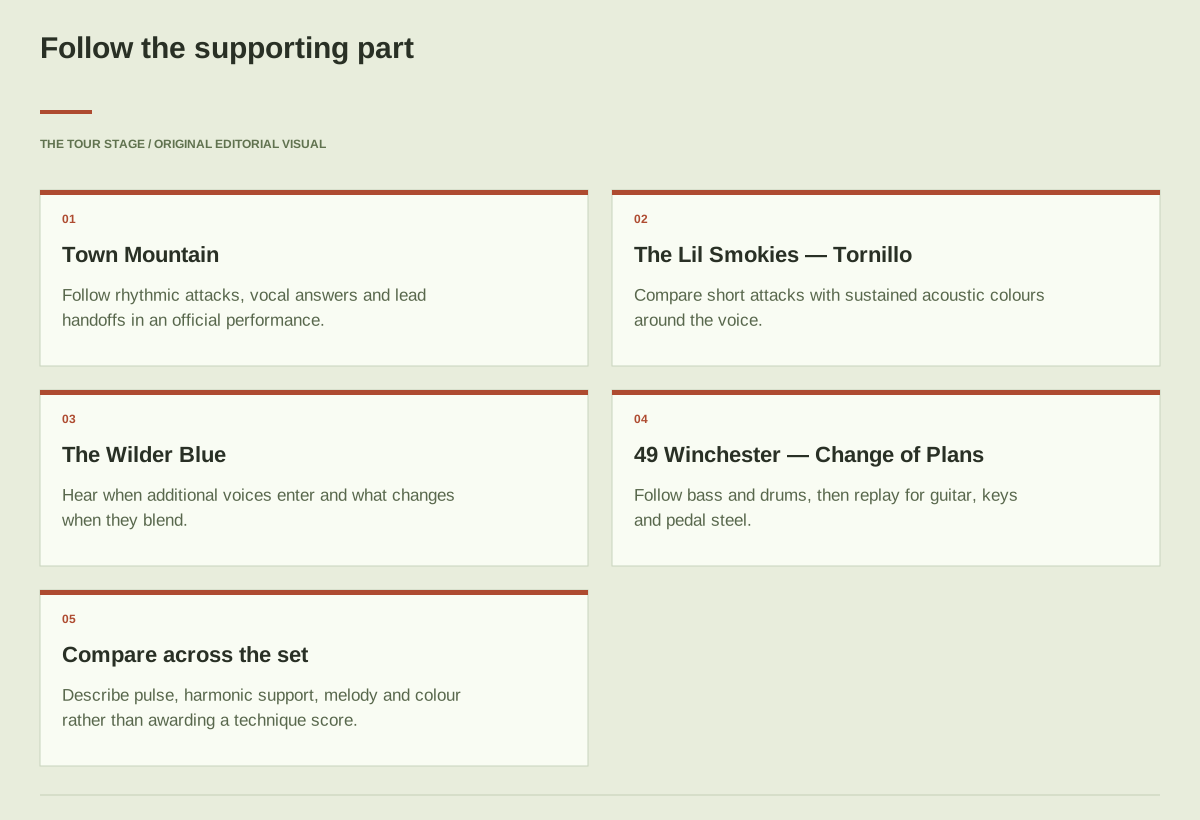
- Town MountainFollow rhythmic attacks, vocal answers and lead handoffs in an official performance.
- The Lil Smokies — TornilloCompare short attacks with sustained acoustic colours around the voice.
- The Wilder BlueHear when additional voices enter and what changes when they blend.
- 49 Winchester — Change of PlansFollow bass and drums, then replay for guitar, keys and pedal steel.
- Compare across the setDescribe pulse, harmonic support, melody and colour rather than awarding a technique score.
Read the visual as text
- Town MountainFollow rhythmic attacks, vocal answers and lead handoffs in an official performance.
- The Lil Smokies — TornilloCompare short attacks with sustained acoustic colours around the voice.
- The Wilder BlueHear when additional voices enter and what changes when they blend.
- 49 Winchester — Change of PlansFollow bass and drums, then replay for guitar, keys and pedal steel.
- Compare across the setDescribe pulse, harmonic support, melody and colour rather than awarding a technique score.
The Lil Smokies: follow colour within an acoustic setting
For the Lil Smokies, Tornillo offers a compact album route, while official artist-linked release listings and performance material provide a way to compare the record with a stage presentation.3 Listen for the difference between a part that marks the beat and a part that extends a note across it. A resonator-guitar sound can bridge those functions: the attack makes a phrase clear while the sustained pitch creates another kind of movement. Do not assume every audible texture comes from the same player throughout the album. Instead, take one passage and describe what enters, what withdraws and what the voice does with the remaining space. This makes the ensemble easier to understand than a list of instruments alone. The bluegrass comparison guide provides additional vocabulary for hearing acoustic roles without forcing every acoustic record into one category.
Compare a flowing arrangement with a clipped one
After a Town Mountain passage and a Tornillo track, compare how the two recordings manage the ends of phrases. Does an instrument answer immediately, overlap the vocal or wait for a pause? Is the accompaniment made of short repeated attacks, longer ringing tones or a changing mixture? These questions give you a precise comparison even if you have not identified every instrument. They also prevent a common listening shortcut in which speed is treated as the only measure of energy. A slower recording can feel highly active when its inner parts keep changing, while a brisk one may establish a deliberately stable pattern. Choose the kind of activity that interests you and follow it through a complete song. You are comparing musical organisation, not deciding which ensemble displays the most technique.
The Wilder Blue: hear harmony as an arrangement decision
The official Wilder Blue electronic press kit identifies its five-part harmony approach and supplies listening entry points including “Palomino Gold,” “Dixie Darlin’,” “Wave Dancer” and “Picket Fences.”4 Start with one named track and attend to the moment a second or additional voice becomes audible. Does the lead remain easy to locate, or does the blend become the principal colour? A harmony entrance can enlarge a chorus, soften a statement or shift attention from an individual to a group. Compare the first and last appearances of the central section rather than assuming a repeated lyric produces an identical performance. Harmony is an active arrangement choice, not merely a sign that several band members can sing. The harmony guide explores those relationships in more detail.
Keep a band’s different records separate
A harmony-focused entry does not describe every record a band will make. The Wilder Blue’s official 2026 publicity identifies Cinco and its production setting, adding another concrete project to explore after the earlier catalogue.5 When you move between records, write the title and version in your notes. Ask whether the newer setting changes which parts seem central rather than assuming the same sonic balance must continue. This is especially useful when a band expands its collaborators or studio palette. A catalogue can retain familiar voices while placing them in different surroundings. The distinction between a group’s identity and one album’s production helps you enjoy change without turning every release into a test of loyalty. It also leaves room for your own preference to be particular: you may favour one arrangement without needing to generalise about the whole career.
49 Winchester: hear the electric ensemble’s internal space
The official artist-controlled Bandcamp page for 49 Winchester’s Change of Plans identifies the record and the band’s instrumental roles, including voice, lead guitar, bass, pedal steel, keys and drums.6 This gives you a different ensemble scale to hear after the acoustic routes. Choose a track and follow the bass and drums first, then replay it for the relationship between keys, guitar and steel. The important question is not simply how much sound is present. It is how the parts avoid competing for the same moment. A sustained colour can remain audible behind a vocal if the arrangement gives it a different register or a different pattern of entrances. Listen for a verse where one instrument holds back and a chorus where it joins. That change may explain the impact more clearly than the label country-rock alone.
Build a four-track ensemble study
Choose one complete track from each route and record a single observation about a supporting part. Then replay the track you found most surprising with your attention returned to the singer. The accompaniment may now make the vocal feel different because you understand what it responds to. Avoid reducing the session to acoustic versus electric: those are useful texture descriptions, but the deeper contrast is in rhythm, space, blend and the transfer of attention. For a second session, reverse the order so that a quieter track follows the fullest arrangement. The instrument-role map can help organise your notes, while the artist finder offers another starting route. A band’s character becomes easier to hear when you notice what happens beneath the obvious lead.
Sources & further reading
- Town Mountain official mediaNamed official videos and performances.
- PBS: Town Mountain first-person interviewMusicians discuss their songs and band context.
- The Lil Smokies artist-linked catalogue hubOfficial artist-linked Tornillo entry.
- The Wilder Blue official press kitHarmony approach and named listening entries.
- The Wilder Blue official publicityCinco production and album context.
- 49 Winchester: Change of Plans artist catalogueReleased album and credited ensemble roles.